If you wake up with lower back stiffness or a nagging ache between your shoulder blades, the spring system inside your mattress is one of the first things worth questioning. The pocket spring vs bonnell spring debate is not just about price or durability — it is about how each coil type manages your spinal alignment, how much it lets your hips and shoulders sink, and whether it transfers your partner's tossing across the bed into your spine. The short answer: pocket springs generally win for side sleepers and lighter bodies because they contour and isolate motion, while bonnell springs often suit firmer-feel preferences and heavier back sleepers who need buoyant, connected support. But the real verdict depends on your sleep position, your body weight, and the specific nature of your back pain.
Quick Takeaways: Which Spring System for Which Sleeper?
- Back sleepers over 90kg: Bonnell's interconnected coils often provide firmer, more uniform support that helps maintain spinal extension.
- Side sleepers under 80kg: Pocket springs reduce pressure-point sink at the shoulder and hip, improving alignment.
- Couples with different schedules: Pocket springs isolate motion far better than bonnell's linked coil network.
- Lower disc pain sufferers: Often benefit from pocket spring contouring that reduces localized pressure on the lumbar region.
- Upper back tension sufferers: May prefer bonnell's firmer, more stable surface that discourages excessive shoulder sink.
- Budget vs longevity: Bonnell is typically cheaper but can sag sooner; pocket springs cost more but maintain individual coil integrity longer.
How Bonnell Springs Actually Work — And Why That Matters for Your Back
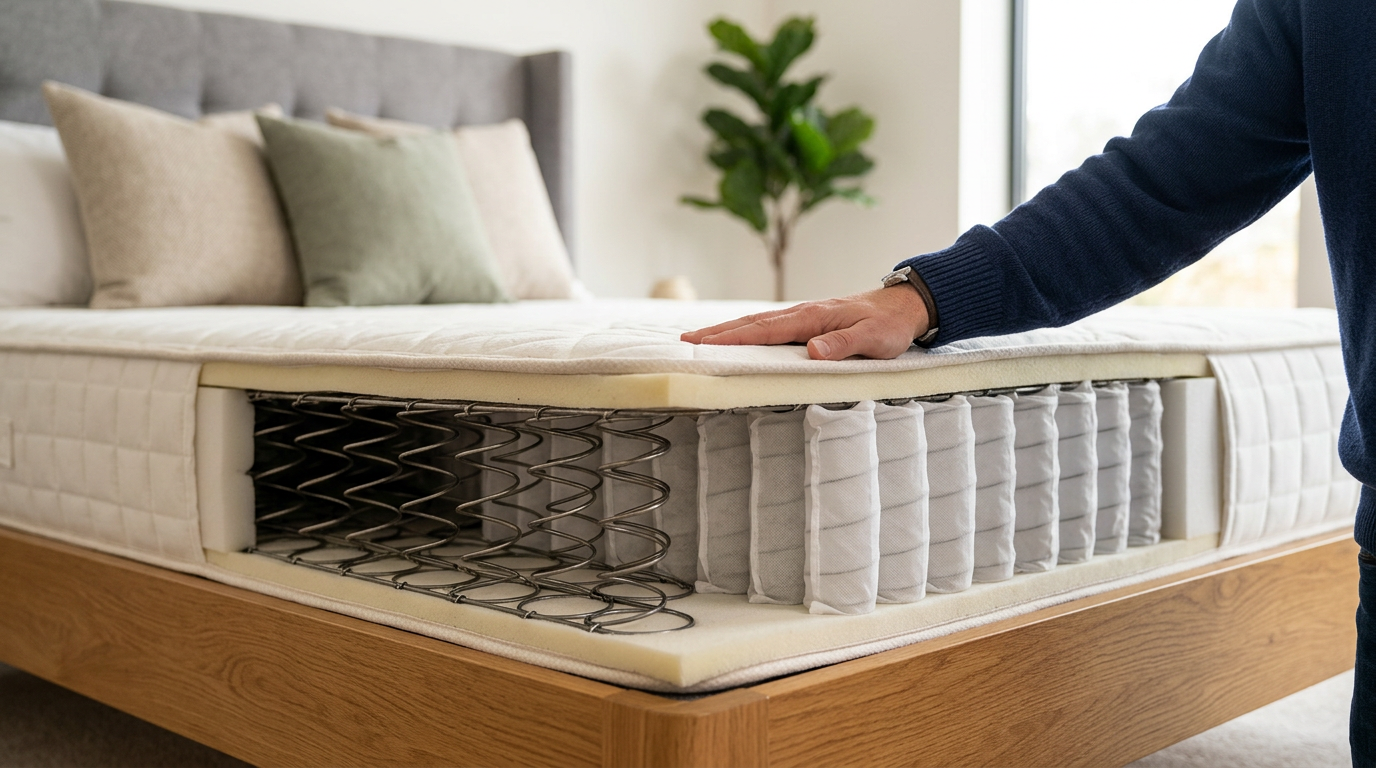
Bonnell springs are the oldest mattress coil design still in wide use. They are hourglass-shaped steel coils connected to each other by a network of spiral wire called a helical lacing. Because every coil is tied to its neighbor, pressure applied to one area of the mattress ripples across the surface. This interconnected design creates a firm, bouncy, and relatively uniform feel.
For your back, this has a specific mechanical consequence. When you lie on a bonnell mattress, your body weight is distributed across a broad area of connected coils rather than absorbed by individual springs. That can be helpful for maintaining a flat, extended spine — particularly if you are a back sleeper with a heavier build who tends to sink too deeply into softer, independently moving coils. But the same interconnectedness means your hip or shoulder does not sink independently. If you are a side sleeper, your heavier hip pushes down and pulls nearby coils with it, which can tilt your pelvis and misalign your lumbar spine.
Bonnell Spring Mattress Pros and Cons for Back Pain
Understanding the trade-offs requires looking at how the coil behavior translates into real sleep outcomes:
- Pro — Firmer, more buoyant surface: Helps heavier back sleepers avoid excessive lumbar sink, which is a common cause of morning lower back ache.
- Pro — Cost-effective: Bonnell systems are cheaper to manufacture, making them accessible if you need a firm mattress on a budget.
- Pro — Good airflow: The open coil structure allows air circulation, which can help sleepers who run hot and associate heat with back tension.
- Con — Motion transfer: Every movement travels across the bed. For couples, this means your partner's shifting can jostle your spine throughout the night.
- Con — Pressure-point rigidity: Side sleepers often experience shoulder and hip pressure because the connected coils resist independent contouring.
- Con — Sagging risk: Over time, bonnell coils can lose temper and develop body impressions, which undermines spinal support.
Who Should Avoid Bonnell for Back Pain
If you sleep on your side, weigh under 80kg, or share the bed with a restless partner, bonnell's connected coil network works against you. The lack of independent movement means your shoulder cannot sink enough to keep your cervical and thoracic spine aligned. Lighter side sleepers often report waking with upper back tension or a pinched feeling near the scapula — a direct result of the shoulder being pushed up and forward instead of cradled.
Pocket Spring Mattress Explained: Independent Coils and Spinal Contouring
Pocket springs — also called pocketed coils or encased coils — are individual steel coils, each wrapped in its own fabric sleeve. Unlike bonnell, the coils are not wired together. Each spring compresses independently based on the pressure directly above it. This creates a mattress surface that conforms more precisely to your body's curves.
For back pain, this independence matters because it allows the mattress to respond differently under your heavier pelvic region versus your lighter waist and neck. A side sleeper's shoulder can sink into its own pocketed coils without dragging the coils under the torso down with it. That localized response helps keep the spine in a more neutral, side-lying position — which is why many physiotherapists and sleep specialists lean toward pocket springs for side sleepers reporting pressure-related discomfort.
Why Pocket Springs Reduce Partner Disturbance
Because each coil moves on its own, motion does not travel laterally across the mattress. If your partner gets up at 5am or rolls over at 2am, the coils under your body stay largely still. For back pain sufferers, this is not just a comfort benefit — it is a recovery benefit. Deep, uninterrupted sleep stages are when muscular repair and inflammation reduction occur. A mattress that keeps your spine still while your partner moves supports that recovery process.
The Trade-Off: Pocket Springs and Heavier Back Sleepers
Pocket springs are not universally superior. If you are a back sleeper weighing over 90kg, the independent coil movement can sometimes work against you. Heavier bodies apply more downward force, and individual coils compress more deeply — sometimes too deeply — under the buttocks and upper back, while the lighter lumbar curve gets less support. This can create a subtle hammocking effect where the hips sink lower than the shoulders and knees, stressing the lower back.
That said, many modern pocket spring mattresses use zoned support — firmer coils in the center third of the mattress to reinforce the lumbar region. If you are heavier and considering pocket springs, look for zoning rather than a uniform coil gauge.
Mattress Spring Types Comparison: How Each Affects Spinal Alignment
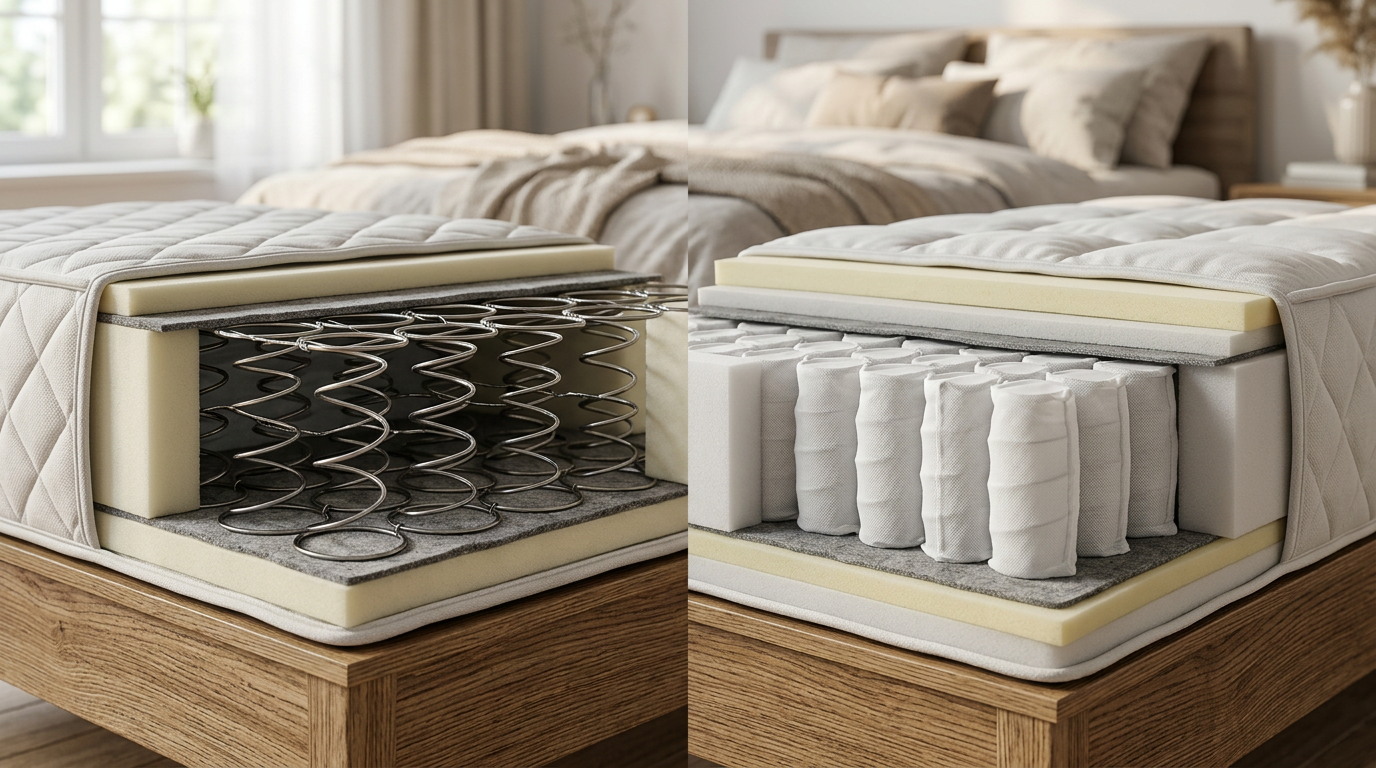
To decide which mattress is best for back pain, it helps to compare how each spring type affects the three mechanical factors that determine spinal health during sleep: alignment, pressure distribution, and motion transfer.
Spinal Alignment
Spinal alignment means your spine maintains its natural curves — cervical lordosis, thoracic kyphosis, and lumbar lordosis — without twisting or sinking unevenly. Bonnell's firm, connected surface supports a flat spine for back sleepers but can force side sleepers into lateral tilt. Pocket springs contour to side sleepers' hips and shoulders, supporting a straight side-lying spine, but may allow heavier back sleepers to sink too far at the pelvis.
Pressure Distribution
Pressure distribution refers to how evenly the mattress spreads your body weight. Poor distribution creates hotspots — usually at the shoulder, hip, or lower back — that restrict blood flow and cause pain. Pocket springs excel here because each coil responds to localized pressure. Bonnell distributes weight across a wider coil network, which reduces hotspot risk for back sleepers but creates pressure at the shoulder and hip for side sleepers.
Motion Transfer
Motion transfer is how much movement on one side of the bed is felt on the other. Bonnell's connected coils transfer motion readily — a disadvantage for couples and for back pain sufferers who need stillness. Pocket springs isolate motion at the coil level, making them the clear winner for shared beds.
The Decision Matrix: Sleep Position, Weight, and Back Condition
Below is a practical decision framework cross-referencing sleep position, body weight, and common back conditions. Use this as a starting point — your individual comfort preferences and mattress construction details still matter, but this matrix reflects how the mechanical behavior of each spring type maps to real-world back pain outcomes.
Back Sleepers
- Under 80kg, no major back issues: Either system can work. Pocket springs offer slightly better contouring; bonnell offers a firmer, more traditional feel.
- Under 80kg, lower disc pain: Pocket springs with zoned lumbar support. The independent coils reduce pressure on the lumbar discs.
- 80–100kg, general back stiffness: Bonnell often provides enough firmness to keep the spine extended without excessive sink.
- Over 90kg, lower back ache from sinkage: Bonnell is usually the safer choice. If you prefer pocket springs, seek a high-coil-count, zoned model with firmer center coils.
- Over 100kg: Look beyond both systems — high-density foam hybrids or reinforced pocket coil systems designed for heavier bodies are typically more durable.
Side Sleepers
- Under 80kg, shoulder or hip pain: Pocket springs are strongly recommended. The independent coil movement lets the shoulder sink, keeping the thoracic spine aligned.
- Under 80kg, upper back tension: Pocket springs reduce the forward shoulder rotation that bonnell's firmness can cause.
- 80–100kg, mixed back and hip pain: Pocket springs with a medium-firm comfort layer. Bonnell's firmness may worsen hip pressure.
- Over 90kg: Pocket springs with zoned support and a denser comfort layer. Pure bonnell may be too firm at the shoulder; standard pocket springs may sink too much at the hip.
Stomach Sleepers
- Any weight: Stomach sleeping is generally discouraged for back pain because it flattens the lumbar curve and stresses the cervical spine. If you cannot change positions, a firmer bonnell surface may prevent the midsection from sinking, which is the primary risk for stomach sleepers.
Combination Sleepers
- If you switch between back and side: Pocket springs are usually more adaptable because the coils respond independently to each position. Bonnell's uniform firmness can feel fine on your back but harsh on your side.
Specific Back Conditions
- Lumbar disc pain: Pocket springs with zoned lumbar support reduce direct pressure on the lower discs.
- Upper back and neck tension: Often related to poor shoulder support in side sleeping. Pocket springs let the shoulder sink, reducing trapezius strain.
- General lower back stiffness (no disc issue): A firmer bonnell surface can provide the stable, extended spine position that reduces morning stiffness.
- Sciatica: Pressure on the lower lumbar region and piriformis area matters. Pocket springs with softer hips and firmer lumbar zoning tend to be better tolerated.
Best Mattress Type for Support: Beyond the Spring System
While the spring system is foundational, it is not the whole story. The comfort layers above the coils — typically memory foam, latex, or polyurethane — significantly affect how the springs' support translates to your back. A bonnell core with a thick latex comfort layer can feel more contouring than a pocket spring core with a thin, firm foam top. When evaluating mattresses, consider the full construction, not just the coil type.
What to Check Before Buying
- Coil count: Higher coil counts in pocket springs generally mean better contouring. Bonnell coil counts matter less because the coils are connected.
- Coil gauge: Lower gauge numbers mean thicker, firmer wire. Heavier sleepers should look for 13–15 gauge; lighter sleepers may prefer 15–17 gauge.
- Zoning: Look for reinforced center-third support in pocket spring mattresses if you have lower back issues.
- Comfort layer material: Memory foam softens pressure points; latex provides resilient, responsive support. Match the layer to your pressure sensitivity.
- Edge support: Firmer edge enclosures help you sit on the bed edge and prevent roll-off, which matters if you have mobility-related back pain.
Frequently Asked Questions
Is pocket spring better than bonnell for back pain?
It depends on your sleep position and weight. Pocket springs are generally better for side sleepers and lighter bodies because they contour and reduce pressure points. Bonnell may be better for heavier back sleepers who need firmer, more uniform support to prevent excessive lumbar sink.
Can a bonnell mattress cause back pain?
Yes, particularly for side sleepers. The interconnected coils resist independent shoulder and hip sink, which can tilt the pelvis and misalign the spine. Bonnell can also cause back pain if the coils have lost temper and developed sagging body impressions.
How long do pocket spring mattresses last compared to bonnell?
Pocket springs typically last 7–10 years, sometimes longer with high-quality construction. Bonnell mattresses often show sagging within 5–8 years because the connected coils wear together. Durability also depends on coil gauge, comfort layer quality, and usage.
Are pocket spring mattresses good for heavy people?
They can be, but you need to choose carefully. Look for high coil counts, lower gauge (thicker) wire, and zoned lumbar support. Standard pocket springs may sink too much under heavier bodies, creating a hammock effect that stresses the lower back.
What is the best mattress type for lower back pain?
For most side sleepers, a medium-firm pocket spring mattress with zoned lumbar support tends to perform well. For heavier back sleepers, a firmer bonnell or reinforced pocket spring system may provide better spinal extension. The best mattress for support is one that keeps your spine neutral in your typical sleep position without creating pressure hotspots.
Conclusion: Choosing the Right Spring System for Your Back
The pocket spring vs bonnell spring decision is not about one being universally better. It is about matching the mechanical behavior of each coil type to your body's specific needs. If you are a side sleeper, weigh under 80kg, or share your bed with a partner, pocket springs' independent contouring and motion isolation usually translate into better spinal alignment and fewer pressure-related aches. If you are a heavier back sleeper who tends to sink too deeply into softer mattresses, bonnell's firm, connected support can help maintain the spinal extension that keeps morning stiffness at bay.
Before you buy, identify your dominant sleep position, weigh yourself honestly, and note whether your back pain is concentrated in the lower discs, the upper back, or both. Then use the decision matrix above to narrow your options. Finally, test the mattress — ideally for at least 10–15 minutes in your typical sleep position — because no spring system compensates for a mattress that simply does not fit your body. Your back will tell you within a few nights whether you made the right choice.
When you are ready to compare spring systems in person or online, start with the mattress, bases and ensemble range, including the Firm Slumber Mattress if you want a firmer Bonnell option.