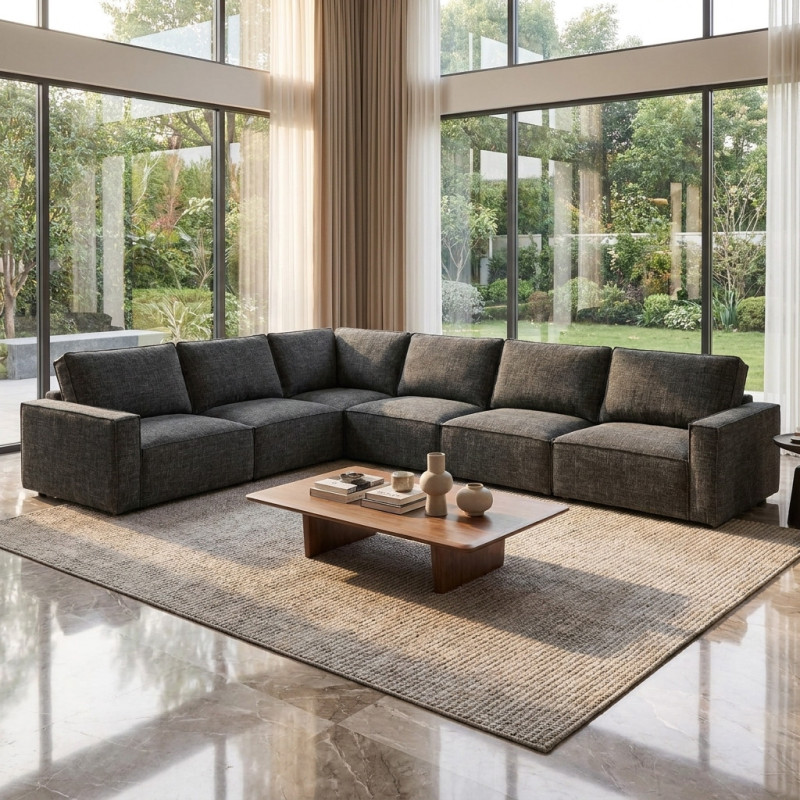
The Maxwell 6-Piece Large Modular Corner Lounge Suite is Austina's largest configurable corner seating system: six individual modular pieces that you arrange into an L-shape, U-shape or long straight run. It is built for big rooms — open-plan living areas, family rooms and home theatres — where a standard three-seater leaves half the space empty and half the family on the floor.
If your room is large or awkwardly proportioned, the practical implication is simple: you stop shopping for "a sofa" and start designing a layout. That is a different buying process, and this guide walks through what actually matters — scale, layout logic, upholstery feel, and the checks to make before you order.
Quick Takeaways
- A 6-piece Maxwell configuration is a system, not a single sofa — the pieces join, split and rearrange as your room or household changes.
- It suits rooms roughly 4 metres and up in both directions. Below that, a smaller Maxwell build usually works better.
- Austina sells factory direct from Perth and Bunbury, with the Maxwell range advertised at warehouse pricing — the 2-seater modular section was listed at $949 (from $1,799) and the 3-seater at $1,299 (from $2,299) at the time of writing.
- "Plush velvet touch" describes a hand-feel family, not a specific fabric. Confirm the exact upholstery and cushion fill on the product page before you commit.
- Measure your delivery path, not just your lounge room. Large modular pieces fail at doorways more often than at floor plans.
Check Warehouse Price & Buy the Maxwell 6-Piece Large Corner Suite
What You Actually Get With a 6-Piece Maxwell Configuration
A six-piece modular suite is a set of individually upholstered modules — corner pieces, single-arm sections, armless centre sections and often an ottoman — that lock together into one continuous seating shape. The count refers to the number of separate units, not the number of seats, so a 6-piece build typically seats five to seven adults depending on how you arrange it.
That distinction matters because it changes how you shop. You are not choosing between "3-seater or 4-seater". You are choosing a total footprint and then deciding how to break it up.
Why modular beats a fixed corner sofa
- Reversibility. A fixed chaise is locked to one side. Modular pieces let you flip the corner when you move house or renovate.
- Reconfiguration. The same six pieces can run as one long wall of seating, an L into the room, or a U that closes off a conversation zone.
- Repairability. One worn or damaged module can be dealt with without replacing the whole suite.
- Delivery logistics. Separate pieces are generally easier to manoeuvre through tight hallways and stairwells than a single welded frame.
The trade-off is assembly and alignment. Modular systems need to be pushed together properly and checked for level, and the joins will show if you move them around carelessly. That is a five-minute job, not a structural problem — but it is worth knowing before delivery day.
Commercial-Grade Scale: Is a Large Corner Suite Right for Your Room?
The Maxwell 6-piece sits at the "commercial-grade space" end of residential furniture. Its footprint and seating volume are closer to what you would specify for a hotel lobby or a corporate breakout area than to a typical suburban three-seater. That is a genuine advantage in a big room and a genuine mistake in a small one.
Room-by-room sizing checks
Before you commit to six pieces, run these checks in order:
- Longest wall. Measure the wall the main run will sit against. If the suite consumes more than about two-thirds of it, the room will feel closed in.
- Return leg depth. Measure how far the corner extends into the room. Anything beyond roughly a third of the room's width starts to block circulation.
- Walkways. As a general interior-design rule of thumb, allow 600–900 mm for main traffic paths and around 400 mm for secondary gaps. Where the suite faces a TV or fireplace, leave enough distance that you are not craning your neck.
- Delivery path. Measure your front door, internal doorways and any stair turns. This is the step buyers skip most often.
- Floor area. A large corner suite needs a proportionate rug. Undersized rugs make big modular seating look like it is floating.
When a 6-piece suite is the wrong call
- Rooms under about 4 m × 4 m. The geometry gets tight and you lose the open feel that makes modular seating worth it.
- Frequent movers. Six modules is a lot of furniture to relocate, even if each piece is manageable.
- Rooms that double as thoroughfares. If people walk through the middle of the room constantly, a U-shape layout will become an obstacle course.
- Single-person households where one generous sofa and a good armchair would use the space better.
The Plush "Velvet Touch" Question: Feel Versus Fact
"Velvet touch" is a descriptive term for hand-feel, not a fibre specification. It covers a broad family of fabrics — cotton velvets, polyester velvets, chenille blends and brushed weaves — that share a soft, dense, light-catching nap. Two sofas can both feel velvet-plush and behave completely differently after two years of family use.
So the useful question is not "is it velvet?" but "what is it made of, and how does it wear?"
What velvet-touch upholstery does well
- Colour depth. A nap catches light from different angles, so the same fabric reads richer and more dimensional than a flat weave.
- Warmth. Velvet-style fabrics feel warmer to sit on than smooth linens or leather, which suits cooler climates and air-conditioned rooms.
- Durability when dense. A tightly woven, high-density velvet resists pilling far better than a loose, low-density one.
- Sound absorption. Plush fabric softens echo — a real benefit in an open-plan space with hard floors.
What to confirm before you order
- Fabric composition and care code. Check the label or product specification. Composition determines how you clean it, and cleaning method determines how long it lasts.
- Cushion fill. Foam, foam-and-fibre wrap, and duck-down feather wraps all feel different. Feather gives a softer sink-in feel but needs regular plumping; denser foam holds its shape with less maintenance.
- Pile direction. Velvet-style fabrics show shading when the pile is brushed in different directions. That is normal, not a fault — but knowing it prevents a lot of unnecessary worry.
- Colour under your lighting. Plush fabrics shift dramatically under warm versus cool bulbs. Ask for a swatch if you are matching to existing decor.
Practical note: Austina lists its Maxwell range at factory-direct warehouse prices, and prices and stock move. Always confirm the current price, fabric options and lead time on the product page rather than relying on any figure quoted elsewhere.
View the Maxwell 6-Piece Large Modular Corner Suite
Three Layouts That Work in Real Australian Living Rooms
Six modules can be arranged more ways than most buyers realise. These three cover the vast majority of real-world rooms.
1. The U-shape conversation pit
Two runs along facing walls with a corner module connecting them at one end. This closes the seating into a social zone and works brilliantly in a square-ish room with a fireplace or media wall on the fourth side. It is the most sociable layout and the worst one for traffic flow — never use it in a room with a through-path.
2. The L-shape with a walk-through corner
One long run plus a return leg, with the corner left open enough to walk past. This is the most versatile configuration and the safest default for open-plan living. You get length for lounging, a defined corner for conversation, and you keep the room feeling connected to the kitchen or dining zone.
3. The theatre-facing run
All six pieces in a shallow curve or straight line facing the screen, with an ottoman acting as a footrest or a movable perch. This suits dedicated home theatre rooms where socialising is not the priority and screen distance is. It also maximises the number of good seats in the room.
How to decide
Ask one question: what is the room's job? Conversation, everyday family living, or screen-watching. Conversation favours U-shapes. Everyday living favours L-shapes. Screen-watching favours a facing run. Most households want the L — and most households that buy a U discover this after the first week.
Worked Example: Planning a 6-Piece Maxwell for a 6 m × 5 m Open-Plan Room
Here is how that decision-making looks in practice for a typical open-plan living area with a kitchen at one end and a sliding door to a deck on the side.
- Identify the anchor wall. The 6 m wall opposite the kitchen becomes the main run.
- Sketch the return. A return leg of roughly 2.5–3 m along the 5 m wall creates an L without blocking the deck door.
- Check circulation. With the L placed, confirm at least a 900 mm path from the kitchen through to the deck door.
- Position the TV or fireplace. Measure viewing distance from the main run and adjust the return leg length rather than the main run.
- Size the rug. The rug should extend under the front feet of every module and out past the ends of the seating.
- Choose the layout direction. Confirm left- or right-hand corner orientation against the door position before ordering — this is the single most common ordering error with modular suites.
- Plan the delivery. Walk the path from the street to the room and measure the narrowest point.
That process takes about twenty minutes with a tape measure and a piece of paper. It prevents almost every regret buyers have with large modular furniture.
Seven-Point Pre-Purchase Checklist
- Room measures at least 4 m in both directions after the suite is placed.
- Corner orientation (left/right) confirmed against doors, windows and traffic flow.
- Delivery path measured at its narrowest point — door frame, not door leaf.
- Fabric composition and cleaning code confirmed from the product specification.
- Cushion fill and maintenance expectations understood.
- Current warehouse price and stock availability checked.
- Assembly requirements and who is doing it decided in advance.
Delivery, Assembly and Long-Term Care
Austina operates as a factory-direct furniture business with locations in Perth and Bunbury, and advertises stock ready for immediate delivery across thousands of in-stock items. That matters for modular furniture specifically: if you need to add a piece later, availability of a matching module is the difference between expanding your suite and replacing it.
For care, keep it simple and consistent:
- Rotate and plump cushions weekly if the fill is fibre or feather.
- Vacuum plush fabric with a soft brush head rather than a hard nozzle.
- Brush pile in one direction to keep shading even.
- Treat spills immediately — plush fabrics wick, and blotting beats rubbing every time.
- Keep the suite out of direct, sustained sunlight to slow colour fade.
Check Stock & Buy the Maxwell 6-Piece Large Corner Suite
Frequently Asked Questions
How many people does a 6-piece modular corner suite seat?
Typically five to seven adults, depending on module widths and how many ottomans are in the configuration. Six pieces means six separate units, not six seats — corner modules take up more width than they provide in seating positions.
Can I add or remove pieces later?
That is the main advantage of modular design, and it depends on whether the same fabric and module are still available when you want to expand. Colour-batch variation is normal in upholstery, so pieces ordered years apart may not match exactly under all lighting.
Will a large corner suite fit through a standard doorway?
Individual modules are far more likely to fit than a single fixed corner sofa. Measure the narrowest point on the delivery path — including stair turns and hallway corners — and compare it against the largest module's dimensions on the product page.
How do I clean velvet-touch upholstery?
Vacuum with a soft brush attachment, brush the pile in a single direction, and blot spills immediately. Always check the fabric care code supplied with the product, because cleaning methods vary between velvet-style fabrics and the wrong product can flatten or stain the nap permanently.
Is factory-direct furniture lower quality than big-box retail?
Factory-direct means fewer intermediaries in the supply chain, not lower specification. Austina advertises 40+ years of industry experience and zero middlemen, with stock held locally. That said, always judge the actual product — fabric, fill, frame and warranty — rather than the sales channel alone.
The Bottom Line
The Maxwell 6-Piece Large Modular Corner Lounge Suite solves a specific problem: how to seat five to seven people comfortably in a large or awkwardly shaped room without buying two mismatched sofas. It rewards buyers who measure first, decide the room's job before the layout, and confirm fabric and fill before ordering. It punishes buyers who guess at corner orientation and delivery access.
Do the twenty-minute measuring exercise, check the current warehouse price and stock, and the decision usually makes itself.