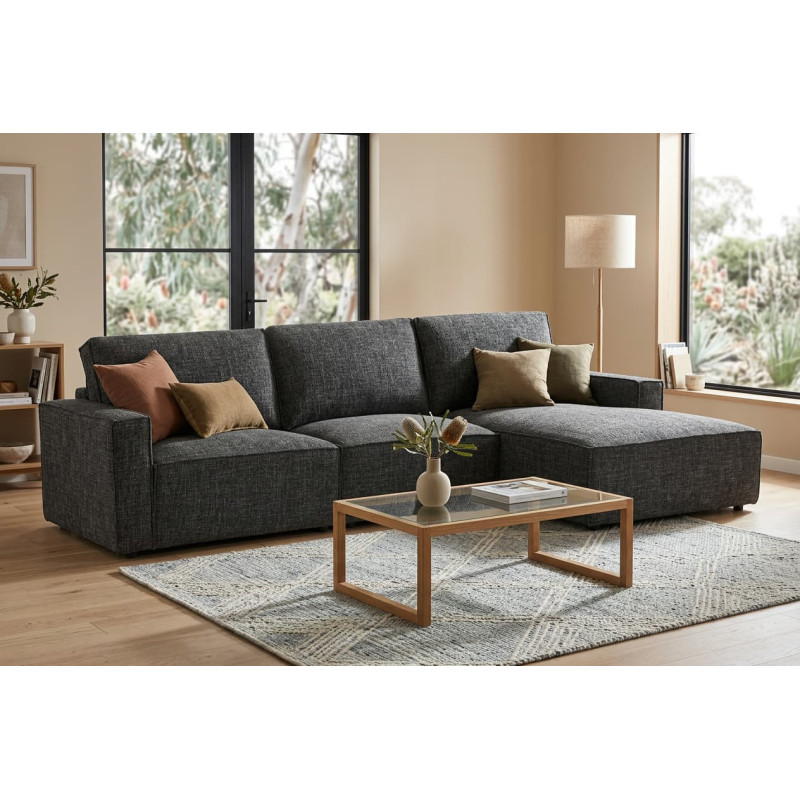
If you're shopping for a sectional, the Maxwell 3-Piece Sectional Sofa with Chaise (LHF/RHF) is probably the shape you're already picturing when you say "we want an L-shape." Three modular pieces, one extended chaise, and a choice of which end the chaise sits on — left-hand facing or right-hand facing. It's the layout that turns a dead corner into the most-used seat in the house, and it's a good example of why the classic L-shape has outlived every furniture trend since the 1990s.
This article covers what the LHF/RHF choice actually means, why an extended chaise earns its footprint, how the Maxwell modular system lets you grow the layout later, and a practical measuring workflow to run before you order.
Quick Takeaways
- Three-piece L-shape with extended chaise — a main run plus a chaise that projects into the room, connected as one continuous seat.
- LHF/RHF means you choose the side. The chaise can sit on the left or right, so the same sofa fits mirrored room layouts.
- Modular, not fixed. Because it's built from Maxwell modular sections, the layout can be reconfigured or extended later.
- Factory-direct pricing. Austina sells direct from Perth and Bunbury with no middleman markup and stock ready for immediate delivery.
- Measure twice. The chaise return depth is the number people get wrong — tape it out on the floor before you commit.
Check Warehouse Price → Maxwell 3-Piece Sectional Sofa with Chaise
What LHF and RHF Actually Mean on This Sectional
LHF stands for "left-hand facing" and RHF for "right-hand facing." On the Maxwell 3-piece sectional, that's simply a mirrored build: the chaise extension sits on the left or the right of the main run when you're standing in front of the sofa looking at it.
The practical implication is straightforward. If your living room's open space is on the left of your TV wall, you need the chaise on the left. If it's on the right, you need the mirror. Ordering the wrong side is the single most common sectional mistake, and it's unfixable without swapping the product.
How to pick your side in under a minute
- Stand in the doorway or entry point you normally walk in from.
- Look at the wall the sofa will run along.
- Ask: which end of that wall has open floor space I want to fill? That's where the chaise goes.
- Confirm the side label (LHF or RHF) on the product page, because labelling conventions can vary between retailers.
If you're genuinely torn, the honest answer is that the chaise side usually matters less than the return depth. Most rooms can only accommodate one orientation once walkways are accounted for — which the measuring section below will settle.
Why the Classic L-Shape Still Beats a Straight Sofa
An L-shape buys you seating density that a straight three-seater can't match, because the corner is otherwise dead space. In a room where the sofa has to anchor a TV wall or mark the boundary of an open-plan living zone, the corner return is free real estate.
The corner does the work
With a straight sofa, the corner behind it collects dust, power cords and a lamp you never turn on. With an L-shape, that same area becomes a seat. For a household that regularly fits five or six people in a living room, this is the difference between "someone's sitting on the floor" and "everyone has a spot."
It defines the room without walls
In open-plan homes, an L-shaped sectional acts as a soft boundary between the lounge zone and the dining or kitchen zone. It's a visual divider that doesn't block sightlines the way a wall or shelving unit would.
When an L-shape is the wrong call
- Very small rooms. If you can't leave a comfortable walkway past the chaise, a straight sofa plus a lightweight armchair will feel less cramped.
- Rooms with doors on two adjacent walls. A corner return can block traffic flow.
- If you rearrange furniture often. L-shapes are heavier and less flexible than separate pieces — although the Maxwell's modular build softens this limitation considerably.
The Extended Chaise: Who It's Actually For
An extended chaise is a lounge, a reading nook and a guest bed alternative in one footprint. It's the piece that gets claimed first in most households, and it's the reason people choose a sectional over a sofa-plus-ottoman setup.
Chaise versus ottoman: a real trade-off
An ottoman is more flexible — you can move it, use it as a coffee table with a tray, or tuck it away. A built-in chaise is more comfortable and never needs repositioning, but it's fixed. If your household genuinely uses a coffee table in the middle of the room, an ottoman-based modular setup may serve you better. If the priority is maximum lounging with minimum furniture juggling, the extended chaise wins.
Who tends to get the most out of it
- Couples who both want to stretch out during movies.
- Households with teenagers who treat the lounge as their main hangout.
- Anyone who reads, works on a laptop, or naps on the couch.
- People in apartments who want one piece that does the job of two.
Build, Comfort and Materials in the Maxwell Range
Austina describes the Maxwell range as premium fabric construction with sturdy craftsmanship and deep cushioned comfort, paired with durable upholstery designed for everyday use. The 3-piece sectional is part of that same modular family, so it shares the range's seating feel and its ability to be combined with other Maxwell sections.
What that means in practice:
- Fabric upholstery — typically more forgiving of everyday life than leather, and warmer underfoot in winter.
- Deep seat cushions — the kind of sink-in comfort that suits lounging rather than formal sitting.
- Modular connectors — pieces join together so the sectional doesn't drift apart on timber or tile floors.
Before ordering, confirm the current fabric options, cushion configuration and exact dimensions on the product page — those details can change between production runs, and the page is the authoritative source.
Buying for the Long Game: How the Maxwell Modular System Works
One of the more useful things about choosing a modular sectional rather than a fixed one is that the layout isn't a life sentence. The Maxwell range includes two-seater sections with left or right arms, three-seater sections, corner pieces, and ottomans. That means the same product family can be built up into larger configurations — a 5-piece corner suite, a 6-piece with ottoman, or a 7-piece for bigger rooms — as your space or household changes.
The practical implication for a 3-piece buyer: you're not locked into exactly three pieces forever. If you move to a larger home, or if a growing family needs more seating, you can add matching Maxwell sections rather than replacing the whole sofa.
What to check before you commit
- Does the current Maxwell range still include the sections you'd want to add later?
- Is the upholstery option you're choosing available across the range, or limited to specific pieces?
- Are the connection mechanisms consistent across sections in the family?
Measure Before You Buy: A Practical Checklist
Most sectional regrets come down to measurement, not quality. Run through this before you order the Maxwell 3-piece.
Step 1: Measure the wall run
Measure the full length of the wall the main section will sit against. Leave a gap at each end — at least the width of a hand — so the sofa doesn't look wedged in.
Step 2: Measure the chaise return
This is the distance the chaise projects into the room. Stand at the open end of the room and picture how far that projection reaches. Anything under about 60 cm of clearance past the chaise and the room will feel tight.
Step 3: Tape it out on the floor
Use masking tape or newspaper to mark the exact footprint for a full day. Sit in the space. Walk past it with a laundry basket. This single step catches more problems than any floor plan.
Step 4: Check the delivery path
Measure your front door, hallway width, stairwell turns and lift dimensions. Modular pieces help here because they arrive as separate sections, but you still need to get each one in.
Step 5: Account for the fixed stuff
Power points, air-conditioning vents, floor registers, curtains, rugs and lamps all interact with a sectional. A chaise that covers the only power point in the room is a daily annoyance.
A quick worked example
Say your lounge wall runs along an open-plan space, with the kitchen island to the left and a hallway to the right. The kitchen side has more open floor, so the chaise goes left — you'd order the LHF configuration. You tape it out, walk past it for a day, and confirm you still have a clear path to the hallway. That's the whole decision, made with a tape measure and 20 minutes.
Factory Direct: What "Warehouse Price" Means at Austina
Austina positions itself as factory direct furniture in Perth and Bunbury — the same standard of furniture you'd find at big-box retailers, sold without the middleman markup. The company advertises 40+ years of industry experience, thousands of in-stock items, a 4.9/5 customer feedback rating, and stock ready for immediate delivery.
For a buyer, the practical benefit is simple: fewer hands between the factory and your living room generally means a lower price for the same build, and faster availability when you need the sofa now rather than in twelve weeks.
What to confirm on the product page
- Current warehouse price and any active reductions.
- Which side (LHF or RHF) is in stock right now.
- Available fabric and colour options.
- Delivery timing and options for your postcode.
View the Maxwell 3-Piece Sectional Sofa with Chaise
Frequently Asked Questions
Can I get the chaise on either side?
Yes — that's what the LHF/RHF designation refers to. The same sectional is built in a left-hand facing and right-hand facing version so it can be mirrored to suit your room.
Is the Maxwell 3-piece sectional expandable?
It's part of the Maxwell modular family, which includes two-seater sections with arms, three-seater sections, corner pieces, ottomans and larger bundled suites. That means the system supports adding pieces rather than replacing the sofa outright.
Will it fit through a standard doorway?
Because it's modular, it arrives as separate sections rather than one solid unit, which makes tight hallways and stairwells more manageable. Measure your narrowest point and confirm the individual section dimensions before delivery.
Is a 3-piece sectional too big for a small living room?
Not necessarily — but the chaise return is the deciding factor. If you can leave a comfortable walkway past the projection, an L-shape can actually make a small room feel more organised than a straight sofa plus a separate armchair.
How long does delivery take?
Austina advertises stock ready for immediate delivery. Timing varies by postcode, so check current availability and delivery options on the product page when you order.
The Verdict: A Layout That Earns Its Space
The Maxwell 3-Piece Sectional Sofa with Chaise is the safest bet in the sectional category for one reason: it does the two things people actually want from an L-shape — it fills a corner with usable seating and it gives one person a place to properly stretch out — without forcing a fixed configuration on you forever. The LHF/RHF option means the same sofa suits mirrored rooms, and the modular build means you can grow it later.
Do the tape-out test, confirm the stock side you need, and check the current warehouse price before someone else takes the last one in that fabric.