Your sofa sags after 12 months because the foam cushion core is too low-density—not because you sit too much, not because the frame is weak, and not because the upholstery is wearing out. The single most predictive spec for long-term cushion performance is foam density, measured in kilograms per cubic meter (kg/m³). Most buyers never see this number before purchase. Retailers use vague terms like "high-density foam" without backing it up, and shoppers confuse firmness with durability. This article breaks down the exact density and ILD numbers you should demand, maps each density grade to a realistic sagging timeline, and gives you a verification checklist so you can stop guessing and start specifying.
While this guide focuses on foam internals, it is also a critical companion to any leather furniture buying guide. Even the finest leather upholstery will disappoint if the foam beneath it collapses. Understanding leather grades explained—from full grain vs top grain leather to bonded leather vs real leather—matters little if your cushions sag within a year. Knowing how to tell quality leather furniture means looking past the surface and into the core.
Quick Takeaways: Foam Density at a Glance
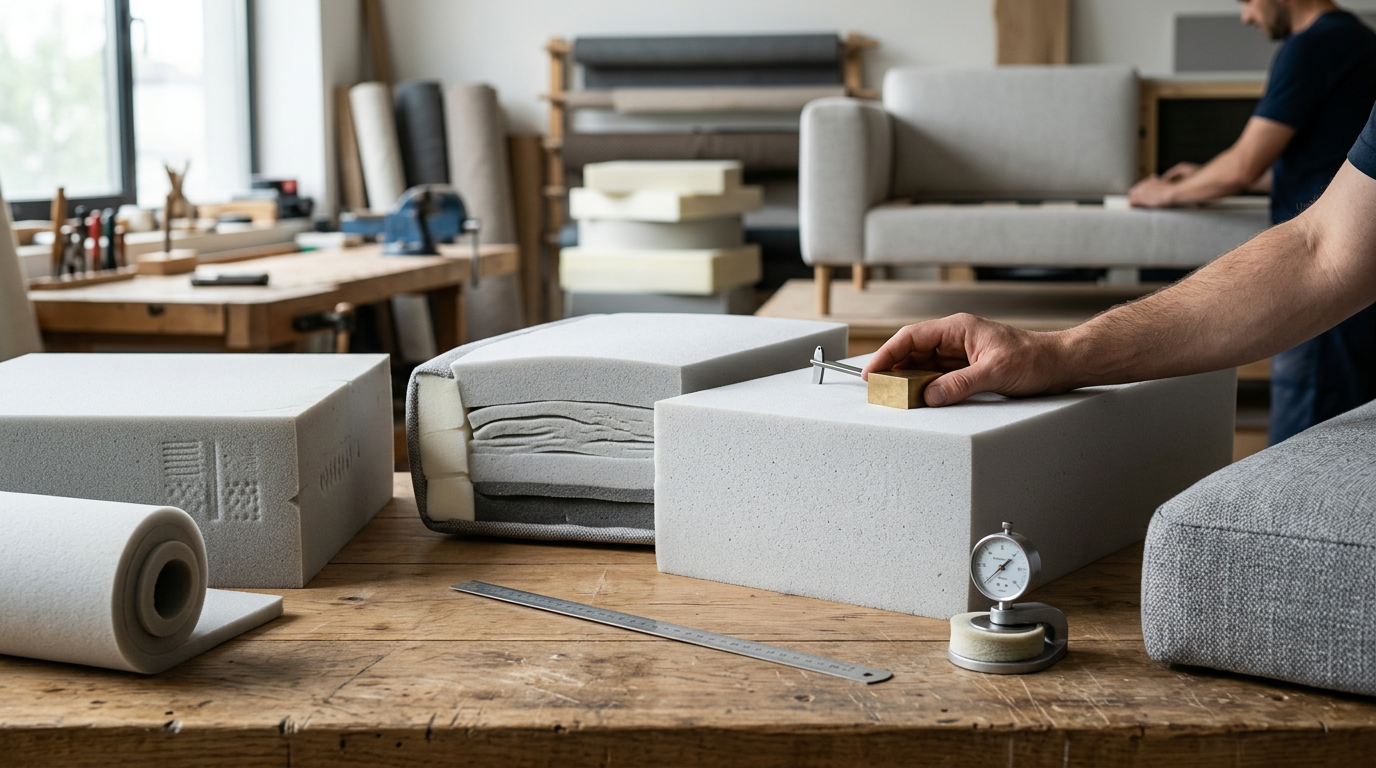
- Density (kg/m³) determines foam lifespan. Higher density means slower degradation.
- ILD (Indentation Load Deflection) measures firmness, not durability. Firm foam can still degrade fast if density is low.
- 18 kg/m³ foam typically begins sagging in 6–12 months of daily use.
- 24 kg/m³ foam holds up for 12–18 months before noticeable softening.
- 28 kg/m³ foam can last 3–5 years with regular residential use.
- 32+ kg/m³ foam is commercial-grade and can last 7–10+ years.
- Always ask retailers for a written spec sheet listing density and ILD numbers.
Foam Density vs ILD: Why Buyers Get Fooled
The most common mistake sofa buyers make is conflating density with firmness. These are two independent properties, and understanding the difference is the foundation of any informed purchase—whether you are comparing types of leather for sofas or evaluating cushion construction.
What Foam Density Actually Measures
Density refers to how much material is packed into a given volume of foam, expressed in kg/m³. A higher density means more polymer per cubic meter, which directly correlates with how long the foam can resist compression fatigue. Density is the primary predictor of cushion lifespan.
Think of it like this: two cushions can feel equally firm when new, but the one with more raw material inside will maintain that feel far longer. A low-density foam might feel great in the showroom and still collapse within a year.
What ILD Measures (and Why It Is Not Durability)
ILD—sometimes called IFD (Indentation Force Deflection)—measures how much force is required to compress the foam by 40% of its height. A lower ILD means softer foam; a higher ILD means firmer foam. ILD tells you how the cushion feels today, not how it will feel in two years.
This is where buyers get trapped. A retailer may say, "This is a firm, high-quality seat." If that firmness comes from a high ILD paired with low density (say, 18 kg/m³), the foam will feel supportive on day one and sag by month twelve. The firmness masks the weakness.
The Density-ILD Matrix: A Quick Reference
- Low density, high ILD: Feels firm, degrades fast. The worst combination for longevity.
- Low density, low ILD: Feels soft, degrades fast. Common in budget sofas.
- High density, low ILD: Feels soft, lasts long. Good for deep, plush seating.
- High density, high ILD: Feels firm, lasts long. Ideal for heavy-use and commercial settings.
When you ask about foam specs, you need both numbers. Density tells you how long the cushion will hold up. ILD tells you whether it will feel soft, medium, or firm when it does.
Foam Density Grades Mapped to Sagging Timelines
Foam density grades are not marketing tiers—they are measurable material categories. Below is a practical mapping of the most common density grades to realistic sagging-onset timelines under daily residential use (defined as 4–6 hours of seated use per day by one to two adults).
15–18 kg/m³: Budget Grade (Sagging Onset: 6–12 Months)
This is the foam found in most big-box retailer sofas under $800. It feels adequate in the showroom and may even feel firm if the ILD is high. However, the cell structure is sparse, meaning air pockets collapse under repeated compression. Within 6 to 12 months, you will notice visible dipping, especially in the center of the seat where body weight concentrates.
If your sofa started sagging within its first year, this is almost certainly the density range you are sitting on. The foam has physically lost material integrity—it is not a frame problem and not a leather problem.
20–24 kg/m³: Mid-Grade (Sagging Onset: 12–18 Months)
This range is common in mid-range furniture and is often labeled "high-density" by retailers—without specifying the actual number. It performs better than budget foam but still softens noticeably after 12 to 18 months of daily use. You may not see visible sagging immediately, but you will feel the cushion bottoming out when you sit.
Many buyers in this tier report that their sofa "felt great for the first year" and then "just went flat." That is the signature degradation curve of 20–24 kg/m³ foam under daily load.
28–30 kg/m³: High-Grade Residential (Sagging Onset: 3–5 Years)
This is where foam starts to deliver genuine longevity. At 28 kg/m³ and above, the polymer structure is dense enough to resist repeated compression for several years. Sofas in this range typically cost more, but the cushion core maintains its shape and support through 3 to 5 years of regular use before any noticeable softening occurs.
If you want a sofa that survives past the 12-month mark without sagging, this is the minimum density you should accept. It is the sweet spot for residential buyers who want durability without paying commercial-grade prices.
32+ kg/m³: Commercial Grade (Sagging Onset: 7–10+ Years)
Foam at 32 kg/m³ and above is engineered for high-traffic environments—hotels, lobbies, waiting rooms, and heavy-use family rooms. It is heavier, more expensive, and can feel quite firm unless paired with a softer topper layer. Under residential use, this foam can last a decade or more without significant sagging.
Some premium sofa manufacturers use 32+ kg/m³ cores wrapped in a down-feather blend or a softer ILD topper (often 1–2 inches of 20–24 kg/m³ foam) to balance durability with comfort. This layered approach gives you the lifespan of high-density foam with a more inviting initial feel.
How to Verify Foam Specs Before You Buy

Most sofa listings do not mention foam density. That does not mean the information is unavailable—it means you have to ask for it. Below is a practical verification workflow you can use with any retailer or manufacturer.
Step 1: Ask for the Spec Sheet
Contact the retailer or manufacturer directly—by phone, email, or live chat—and request the foam specification sheet for the sofa model you are considering. A reputable manufacturer will have this document. It should list the density (kg/m³) and ILD for each cushion layer.
If the response is vague—"It is high-density foam"—ask a follow-up: "Can you provide the exact density number in kg/m³?" If they cannot or will not provide it, treat that as a red flag. Vague language without numbers is a marketing shield, not a quality guarantee.
Step 2: Decode Marketing Language
Here is how common retail terms typically translate into actual foam specs:
- "High-density foam" → Often 20–24 kg/m³. Not bad, but not premium. Ask for the number.
- "Premium foam" → Meaningless without a density figure. Could be anything.
- "High-resilience foam" → Usually refers to HR (High Resilience) foam, which is typically 28+ kg/m³. Better, but still verify.
- "Commercial-grade foam" → Should be 32+ kg/m³. Confirm before trusting the label.
- "Memory foam seat" → Memory foam is a comfort layer, not a structural core. Ask what density the base layer is.
Step 3: Check for Layered Construction
Quality sofas often use a layered foam system: a high-density core (28+ kg/m³) for structural support, topped with a softer layer (lower ILD) for comfort. Ask the retailer to describe the cushion construction layer by layer. If they can only describe the top layer, they may not know—or may not want you to know—what is underneath.
Step 4: Weigh the Cushion
If you are shopping in person, lift a seat cushion. A 28+ kg/m³ foam cushion in a standard sofa size (approximately 50×60×15 cm) will feel noticeably heavier than a 20 kg/m³ cushion of the same size. Weight is not a spec, but it is a practical field test. Dense foam is heavy foam.
What to Do If Your Sofa Already Sags
If your sofa has already started sagging, you do not necessarily need to replace the entire piece. Foam replacement is a viable option, and it is often the single most cost-effective upgrade you can make to extend the life of your furniture.
Identify the Sagging Layer
Most sagging comes from the seat cushion foam, not the frame or the back cushions. Remove the seat cushion cover (if zippered) and inspect the foam core. If the foam has visible compression lines, feels noticeably softer in the center than the edges, or has shrunk from its original dimensions, the core has degraded and needs replacement.
Order Replacement Foam by Spec
You can order custom-cut replacement foam from specialty suppliers. Specify the exact dimensions of your cushion and request a density of at least 28 kg/m³ for residential longevity. If you want a firmer seat, pair it with a higher ILD (around 35–45). If you prefer a softer feel, choose a lower ILD (around 25–30) but keep the density at 28 or above.
This is also your opportunity to upgrade. If your original foam was 20 kg/m³, replacing it with 30 kg/m³ will give you a cushion that outlasts the original by several years—often for a fraction of the cost of a new sofa.
Consider a Foam Topper for Minor Sagging
If the sagging is mild and the foam core is still structurally intact, a 1-to-2-inch foam topper (28+ kg/m³) inserted inside the cushion cover can restore support and comfort. This is a temporary fix, not a permanent solution, but it can buy you 12–18 months while you plan a full replacement.
Why Foam Quality Matters Even with Premium Leather
Many buyers invest in premium leather upholstery—carefully comparing full grain vs top grain leather, studying bonded leather vs real leather, and learning how to tell quality leather furniture—only to have the sofa sag within a year because the foam underneath was never specified. The leather may age beautifully, but if the cushion collapses, the entire sofa feels cheap.
This is why foam density deserves the same scrutiny as leather grade. A sofa upholstered in full-grain leather over 18 kg/m³ foam is a mismatch: premium exterior, budget interior. The result is a piece that looks expensive but feels broken after twelve months.
When evaluating types of leather for sofas, ask the retailer about the foam specs at the same time. A knowledgeable salesperson should be able to discuss both. If they can detail the leather origin, grade, and finish but go silent when you ask about cushion density, you are dealing with someone who knows the surface but not the structure.
Frequently Asked Questions
What foam density should I look for in a sofa?
For residential use, aim for a minimum of 28 kg/m³. If you want the cushion to last 5+ years without sagging, 30–32 kg/m³ is ideal. Anything below 24 kg/m³ is likely to soften noticeably within 12–18 months.
Is high-density foam the same as firm foam?
No. Density and firmness are separate properties. Density (kg/m³) determines durability. Firmness (ILD) determines how the foam feels. You can have soft, high-density foam or firm, low-density foam. Always check both numbers.
Can I fix a sagging sofa without replacing the whole thing?
Yes. In most cases, you can replace just the seat cushion foam. Order custom-cut foam at 28+ kg/m³ from a foam supplier, using your existing cushion dimensions. This is far cheaper than buying a new sofa and can extend the life of your furniture by several years.
How long should a good sofa last before sagging?
A sofa with 28+ kg/m³ foam should last 3–5 years before any noticeable sagging under daily residential use. With 32+ kg/m³ foam, that timeline extends to 7–10+ years. If your sofa sags within the first year, the foam density is likely below 20 kg/m³.
Do retailers have to provide foam specs?
There is no legal requirement, but reputable manufacturers maintain spec sheets for their products. If a retailer cannot or will not provide density and ILD numbers, that is a signal to look elsewhere. Transparency about materials is a marker of quality.
Conclusion: Demand the Numbers
Sofa sagging after 12 months is not a mystery—it is a predictable outcome of low-density foam. The fix is not softer cushions, a better frame, or more expensive leather. The fix is knowing the density number before you buy and refusing to accept vague marketing language in place of real specifications.
Before your next purchase, ask for the spec sheet. Confirm the density is 28 kg/m³ or higher. Check the ILD to ensure the firmness matches your preference. If your current sofa already sags, replace the foam core with a higher-density alternative. These are not luxury upgrades—they are the baseline for furniture that actually lasts.
And if you are shopping for a leather sofa, remember that leather grades explained is only half the story. The other half is what sits beneath the leather. Demand quality in both layers, and your sofa will look and feel right for years—not months.
When you are comparing construction, start with the lounge furniture range and check the build of pieces such as the Windsor 3-Seater Recliner Sofa.