Factory direct furniture in Perth means one thing in practice: you buy from the business that imports and warehouses the stock, instead of from a retail showroom that bought it through a wholesaler. The clue is in the price gap. Austina's own listings publish a corner modular at $5,799 with a warehouse price of $2,899, and a two-seater electric recliner at $3,399 against $1,699. Those are not small roundings — they are roughly half. This article explains where that removed cost actually came from, and how to test the same claim before you spend money anywhere.
Quick Takeaways
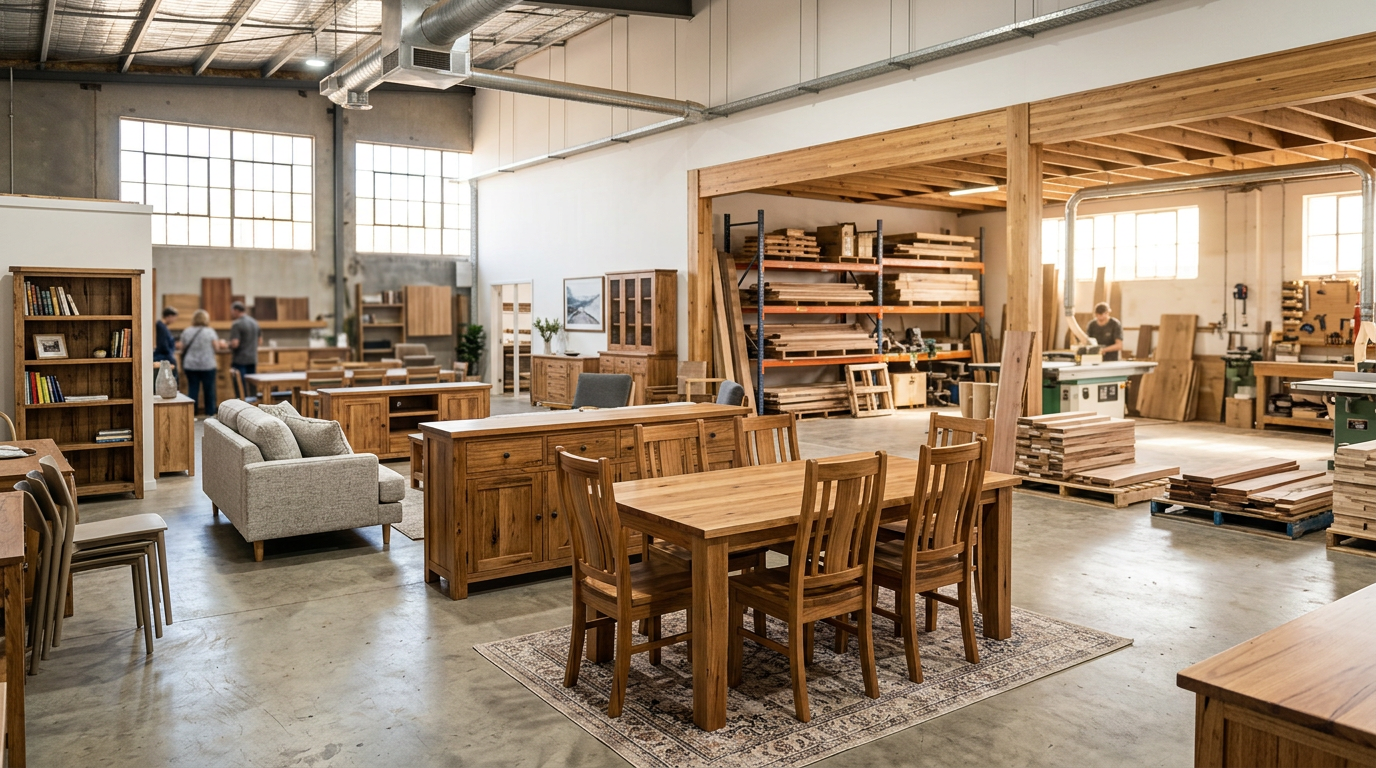
- Factory-direct savings come from removing layers — importer, wholesaler, retail showroom, floor-stock overhead — not from thinning out materials.
- The published gaps across Austina's new arrivals and most-demanded ranges mostly sit between roughly 40% and 50% off, with some variance either side.
- A big percentage off tells you nothing on its own. It only means something next to a construction spec — springs, filling, cover material, warranty.
- In-stock means you can usually see and sit on the piece before committing, and take delivery far sooner than a 12-week special order.
- Any "was/now" price in Australia is supposed to reflect a genuine previous price. That gives you a fair standard to hold sellers to.
The markup chain: where a sofa's price actually goes
Most imported furniture sold in Australia passes through up to four sets of hands before it reaches a loungeroom. Each layer has real costs to cover and needs its own margin. Stack them and the same sofa can leave a showroom at a multiple of what it cost to land in Fremantle.
Layer 1: The importer
An importer buys containers from a factory, then pays freight, customs, duty and quarantine costs, and holds the goods until someone buys them. Their margin covers the working capital tied up in stock and the risk of a container sitting unsold for months.
Layer 2: The wholesaler
A wholesaler buys in bulk and breaks it down for retailers in smaller quantities. Their margin pays for warehousing, pick-and-pack, and the credit terms they extend to shops that want to pay in 30 or 60 days.
Layer 3: The retail showroom
A large-format furniture showroom is an expensive way to sell a sofa. Rent on a big retail site, lighting, air conditioning, car parking, sales staff, and a floor full of display models that will never sell at full price — all of it is priced into the ticket on the item you take home.
Layer 4: Floor-stock overhead
Retail floors usually carry one of everything so customers can compare. Those display pieces eventually sell as run-outs, ex-floor stock or clearance, often at a loss. The cost of that churn is built into the pricing of everything else in the store.
None of these layers are dishonest — they are just expensive. But here is the point that matters: the further a sofa travels down that chain, the more margins are stacked on top of it. The gap Austina publishes between a listed price and a warehouse price is effectively a visible record of that chain being shortened.
What a factory-direct warehouse operation actually changes
A factory-direct warehouse removes structural cost, not material. Austina has been sourcing furniture for more than 40 years and describes its model as zero middleman, with thousands of items held in stock for immediate delivery across Perth and Bunbury. Those four words — zero middleman — are doing the heavy lifting on the price tag.
Container-direct purchasing
Decades of relationships with factories mean buying directly at container volume rather than through a local importer or wholesaler who adds their own margin before the goods ever reach a shelf.
No showroom rent
Warehouse space in an industrial area costs a fraction of a prime retail strip. That single line item — rent — is one of the biggest differences between a showroom model and a warehouse model.
Stock held, not ordered per sale
When thousands of items are already in the country and on the floor, you are not funding a special order, a future container, or a wholesaler's holding period. You are buying something that already exists and is already paid for.
Why that does not automatically mean thinner foam
Nothing about a shorter supply chain forces a manufacturer to use cheaper springs or thinner cushioning — a shorter chain and a cheaper build are two separate decisions. But because a big discount could hide either one, the next section is about proving it on the piece you are actually considering.
Reading the price gap on real listings
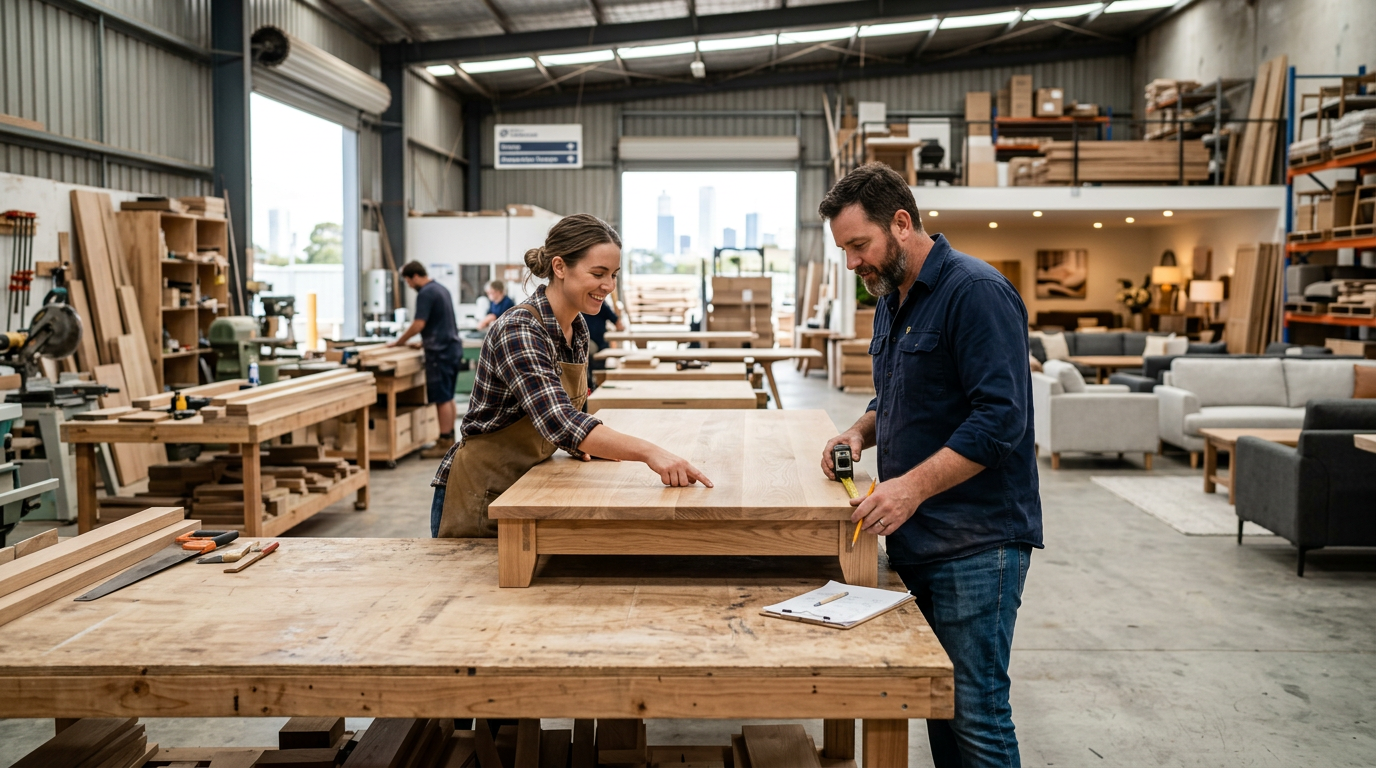
One of the more useful things about Austina's site is that the gaps are published rather than implied. Here is what the listings on their new arrivals and most-requested lounges sections show.
- Corner modular: $5,799 down to $2,899 — a $2,900 gap
- 2-seater electric recliner sofa: $3,399 down to $1,699 — $1,700
- Single electric recliner: $1,799 down to $899 — $900
- Corner modular lounge: $4,499 down to $2,299 — $2,200
- Corner modular with ottoman: $5,299 down to $2,999 — $2,300
- 3-seater chaise with storage and sofabed: $2,999 down to $1,599 — $1,400
- Corner modular recliner suite: $2,899 down to $1,649 — $1,250
- 5-seater pocket-spring reclining sofa suite: $2,999 down to $1,829 — $1,170
Most of those sit somewhere in the 40% to 50% range, with a few outliers on either side. That consistency is worth noticing. Random clearance pricing tends to be messy and scattered; a structural cost difference tends to produce a similar ratio across a whole range.
What that gap does and does not tell you
It tells you the seller is offering the item for substantially less than the price they state as the starting point. It does not tell you the starting point was the cheapest price available anywhere, and it does not tell you the construction is identical to a more expensive competitor's version of the same shape.
In Australia, two-price advertising is regulated. A "was" price is meant to reflect a price the item was genuinely offered at, for a reasonable period, in the recent past. You are not being unreasonable by asking a seller what that baseline price was and when it applied.
A discount is a claim about the seller's process. A spec sheet is a claim about the product. Judge them separately.
How to sanity-check any "factory direct" or "warehouse price" claim
This applies to Austina and to every other seller using the same language. Three checks will separate a genuine supply-chain saving from a marketing label.
1. Compare construction specs side by side, not adjectives
Words like "premium" and "luxury" appear on every listing in the country. Specifications are harder to fake. Ask specifically about:
- Springs: pocket spring versus standard or zig-zag spring. Pocket springs are individually encased, so they move independently — a meaningful difference in both comfort and cost. Austina's reclining sofa range lists pocket spring explicitly, which is a good sign that the term is being used as a spec rather than a slogan.
- Cover material: a named leather pack, like the Aire leather used on Austina's full-motion recliner suites, versus generic "bonded leather" or "leather-look" fabric. These are not comparable products and should not be compared on price alone.
- Cushion fill: duck down versus polyester fibre. Austina lists duck down feathers on at least one ottoman — that is a real material cost difference, not a marketing flourish.
- Mechanisms and warranty: on any recliner, ask what the mechanism is rated for and how long it is covered. This is where cheap builds fail first.
2. Ask whether the item is in stock or a special order
This is the single most underrated question in furniture buying. An in-stock item in a Perth or Bunbury warehouse can be delivered in days. A special order can run around 12 weeks from a factory overseas, plus shipping and customs, and that timeline can stretch. Ask for a delivery estimate in writing before you pay a deposit.
3. Be sceptical of a discount with no quality baseline
"50% off" means nothing if you cannot establish what the item is, what it is made of, and what it would otherwise cost. A percentage needs an absolute to attach to. If a seller cannot or will not talk about construction, the discount is the only thing being sold.
In-stock in Perth versus waiting on a special order
For most buyers, the practical difference between these two paths matters more than a few hundred dollars. Buying in stock means the piece exists, you can usually inspect it, and your lounge is furnished this month. A special order means paying now for something that arrives next season.
Why you should sit on it before you commit
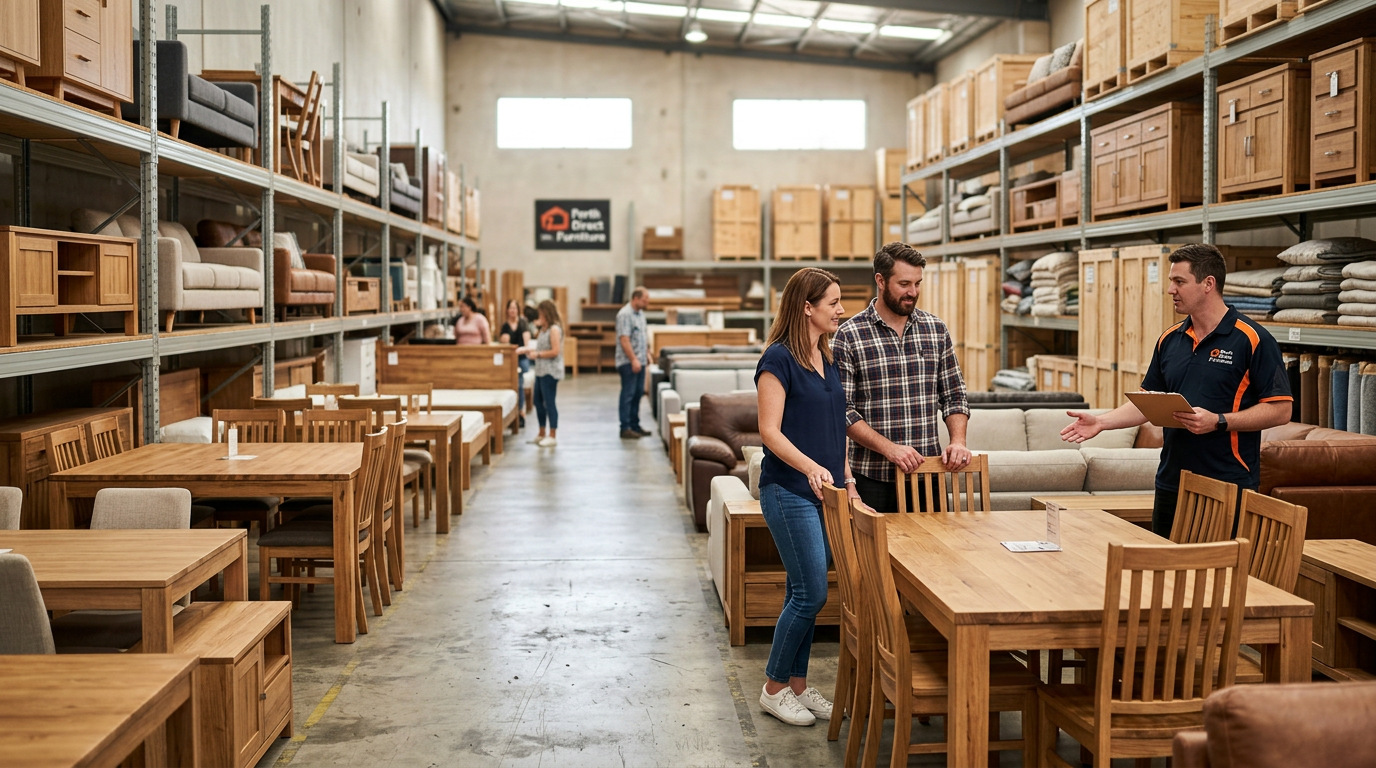
Furniture is one of the few major purchases where fit is entirely personal. Seat depth, back height and cushion firmness vary enormously between two sofas with near-identical photos. Warehouse shopping normally means you can sit on the actual item rather than a styled display version of it — which is a genuine advantage of the model.
The trade-off is presentation. A warehouse typically has a smaller styled footprint than a big showroom, so do not expect every configuration to be set up in a room setting. Call ahead and confirm the specific piece you want to see is physically on the floor.
A five-point checklist before you visit a warehouse
- Confirm the model is on display. Warehouses hold stock; they do not always hold floor displays of every line.
- Bring room and doorway measurements. A corner modular that will not clear a hallway is a problem no discount fixes.
- Confirm which price applies. Ask whether the warehouse price is the final price or depends on a promotion.
- Request the spec sheet. Springs, filling, cover material, frame, and warranty in writing.
- Ask about delivery windows and extras. Timing, cost, assembly, and whether removal of your old furniture is included.
If you are in the South West, check which location holds the item you want — Bunbury and Perth are roughly a two-hour drive apart, and stock is not always mirrored between the two.
Frequently asked questions
Is factory direct furniture cheaper because it is lower quality?
Not automatically. A shorter supply chain and a cheaper build are independent decisions. The way to tell them apart is to compare specifications — springs, filling, cover material, mechanism and warranty — rather than comparing prices alone. Ask for the details in writing.
Why do the price gaps on these listings look so large?
Because they are removing several margin layers at once: wholesaler margin, showroom rent, showroom staffing, and display-floor churn. When four separate cost centres disappear from a product's journey, a large published gap is entirely plausible. It should still be checked against the construction spec.
Are warehouse prices negotiable?
That depends on the individual seller, and it is worth asking directly rather than assuming either way. What you can do regardless is confirm whether the published warehouse price is current, and whether delivery or assembly is included in it.
What is the difference between buying in Perth and in Bunbury?
Mainly logistics. Both are listed as locations for Austina's factory-direct operation. If you are closer to one, that is the one to visit — but confirm the specific item you want is held there before making the trip.
Do I have to buy a whole suite?
No. Most warehouse operations sell individual pieces as well as full configurations, which is useful if you are replacing one recliner rather than refurnishing a room. Check the range first and build from there.
The bottom line
Factory direct furniture in Perth is not a magic trick and it is not a quality compromise by default. It is a supply-chain decision: buy container-direct, skip the wholesaler, skip the showroom rent, hold the stock yourself, and pass the difference on. The published gaps on Austina's listings — roughly 40% to 50% across a broad range of lounges and recliners — are consistent with that explanation rather than contradicting it.
The part that is up to you is the verification. Compare specs, not adjectives. Ask whether the item is in stock or a special order. Get delivery timing in writing. And if the discount is the only thing a seller can talk about, that is your answer.
Start by browsing the ranges rather than individual items, so you are comparing like with like: Lounge Furniture, Dining Furniture, Bedroom Furniture, Mattress, Bases and Ensemble, Bar Stools, and Decorator Items and Interior Design. From there, call and ask the three questions above before you commit.