That $4,000 sofa sitting in a showroom? The actual cost to produce it—from raw materials to factory labor—is roughly $1,200. The remaining $2,800 is what the furniture retail markup covers: international shipping, import duties, warehousing, showroom rent, sales commissions, and retail profit margins. Understanding this breakdown helps answer the common question of why is furniture so expensive and reveals where buyers can potentially save.
Quick Takeaways
- A typical $4,000 sofa costs approximately $1,200 to manufacture at the factory level.
- International logistics, duties, and warehousing add roughly $600–$900 to the cost.
- Showroom overhead, commissions, and retail profit account for the largest share of markup.
- Exploring factory direct furniture and warehouse direct furniture options can reduce final prices by 30–50%.
- Knowing where the markup lives helps you decide which furniture purchases are worth paying retail for.
Factory to Port: What the Sofa Actually Costs to Make
Before a sofa reaches a container ship or a showroom, it starts as raw materials and labor. This is the foundational cost layer—and it's far smaller than most consumers realize. For a mid-to-high-end upholstered sofa retailing at $4,000, the total factory cost typically lands between $1,000 and $1,400.
Raw Material Costs
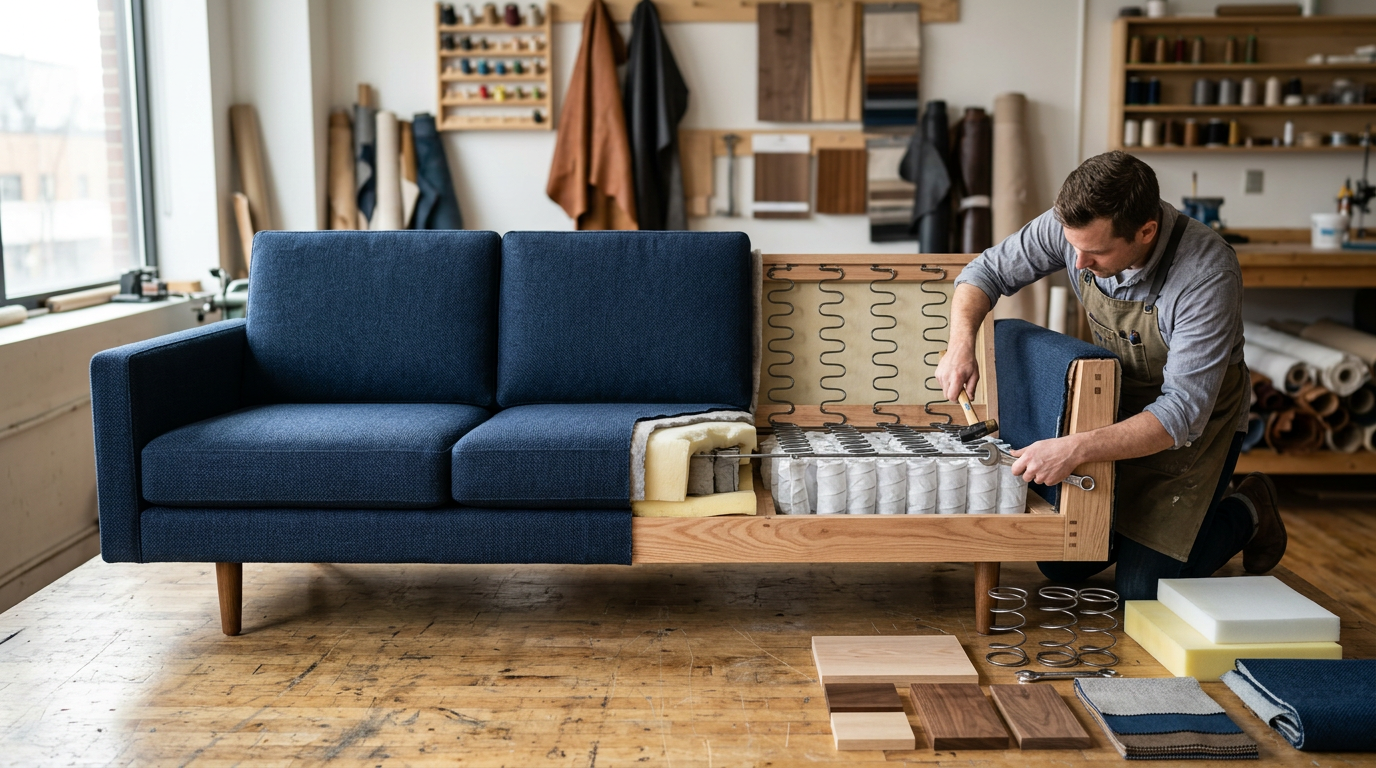
The bulk of factory cost goes into materials. A quality sofa requires a kiln-dried hardwood frame (often maple or oak), high-density foam cushions, sinuous springs or eight-way hand-tied springs, batting, webbing, and upholstery fabric. Here's a rough breakdown for a standard three-seat sofa:
- Frame lumber: $80–$150 depending on wood grade and sourcing
- Springs and webbing: $40–$70
- Foam and cushion fill: $120–$200 for medium-to-high density foam
- Upholstery fabric: $150–$400 depending on whether it's linen, velvet, performance fabric, or leather
- Batting, thread, zippers, and sundries: $30–$60
That puts raw materials somewhere in the $420–$880 range. Fabric choice is the biggest variable—a sofa upholstered in top-grain leather can push material costs significantly higher than one covered in a synthetic blend.
Manufacturing Labor
Assembly labor includes frame cutting, joinery, spring tying, foam cutting, sewing, and final upholstery. In countries like Vietnam, China, or Indonesia—where many export-grade sofas are produced—skilled factory labor might cost $3–$8 per hour. A sofa requiring 12–18 labor hours at those rates adds roughly $50–$150 in direct labor. In higher-wage countries like the United States or Italy, labor can add $300–$600 or more to the same product.
Factory Overhead and Profit Margin
Factories also carry overhead: equipment maintenance, facility costs, quality control, management salaries, and packaging materials. This overhead typically adds 15–25% on top of direct materials and labor. The factory then applies its own profit margin—usually 10–20%—before selling to an importer or distributor. So a sofa with $700 in materials and $100 in labor might leave the factory door at around $1,100–$1,300.
The Logistics Gap: Getting the Sofa from Factory to Warehouse
Once the sofa leaves the factory, a new cost layer begins. This is the logistics gap—the stretch between the factory floor and the retailer's warehouse. It's where the furniture middleman markup starts to accumulate, and it often adds $600–$900 to the cost of a single sofa.
International Freight and Container Shipping
Most import-grade furniture travels by ocean freight in 40-foot containers. A single container can hold roughly 25–40 sofas depending on size and nesting. Container shipping rates fluctuate widely—anywhere from $2,000 to $8,000 per container depending on route, season, and global supply conditions. At an average of $4,000 per container holding 30 sofas, that's about $133 per sofa in ocean freight alone.
Import Duties and Customs
Upholstered furniture imported into the United States typically carries a duty rate of around 1–6% depending on classification and country of origin. For a sofa valued at $1,200 at customs, duties might add $12–$72. There are also customs broker fees, merchandise processing fees, and harbor maintenance charges—small individually but collectively meaningful.
Domestic Warehousing and Handling
Once the sofa clears customs, it moves to a domestic warehouse. Warehousing costs include rent, labor, insurance, and inventory carrying costs. For furniture, which is bulky and requires careful handling, warehousing can add $50–$150 per unit. Damage and return processing also factor in—retailers build a percentage of expected damage into their pricing.
Last-Mile Distribution
Getting the sofa from the warehouse to the customer's home is expensive. White-glove delivery—where a two-person team carries the sofa inside, assembles it, and removes packaging—can cost $150–$300 per delivery. Even standard threshold delivery runs $80–$150. These costs are often partially absorbed by the retailer and partially passed to the consumer as a delivery fee, but they still influence the overall pricing structure.
Showroom Overhead and Retail Profit: The Final Markup Layer
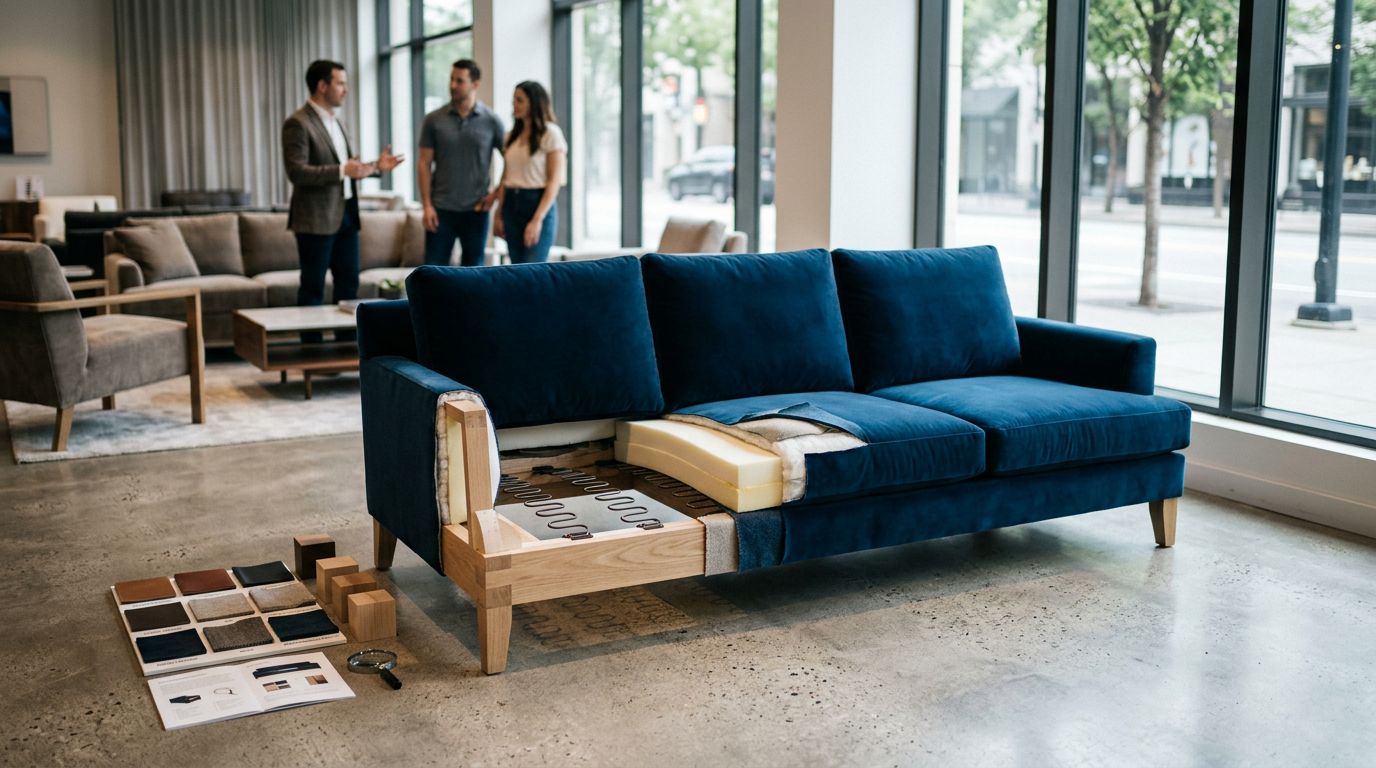
The largest single contributor to the furniture retail markup is the retail layer itself. This is where the sofa transforms from a $2,000 landed-cost product into a $4,000 retail item. Understanding this layer is key to understanding why showroom prices feel so disconnected from perceived material value.
Rent and Showroom Costs
Furniture showrooms require significant square footage. A retailer in a major metropolitan area might pay $30–$60 per square foot annually. A 20,000-square-foot showroom at $40 per square foot costs $800,000 per year in rent alone. Add utilities, insurance, fixtures, and display upkeep, and the overhead grows further. These costs are distributed across every piece of inventory sold.
Sales Commissions and Staffing
Many furniture retailers operate on a commission-based sales model. A salesperson might earn 5–10% commission on a sale. On a $4,000 sofa, that's $200–$400 going directly to the salesperson. Add base salaries for non-commission staff, managers, and administrative personnel, and labor costs at the retail level are substantial.
Brand Positioning and Marketing
Brand perception plays a major role in retail pricing. A sofa sold under a luxury brand name can command a 2x or 3x markup over a structurally similar product sold under a value brand. Marketing spend—advertising, catalogs, social media, influencer partnerships, and PR—is folded into the retail price. For premium brands, marketing can represent 10–15% of the final price.
Retail Profit Margin
After covering all costs—materials, labor, freight, duties, warehousing, delivery, showroom overhead, commissions, and marketing—the retailer needs to earn a profit. Gross margins in furniture retail typically range from 40–60%. That means a sofa with a $2,000 landed cost might be priced at $3,300–$5,000 at retail. The $4,000 price tag in our example sits squarely in this range.
Itemized Cost Breakdown: The $4,000 Sofa
To make this concrete, here's an estimated itemized breakdown of where the money goes on a typical $4,000 retail sofa:
- Raw materials: $600
- Manufacturing labor: $100
- Factory overhead and profit: $300
- Ocean freight: $135
- Import duties and customs fees: $50
- Domestic warehousing and handling: $100
- Last-mile delivery (partial): $115
- Showroom rent and overhead allocation: $400
- Sales commission: $300
- Marketing and brand costs: $400
- Retail profit margin: $600
These figures are illustrative and vary by brand, region, and product type—but they reflect the general structure of furniture pricing. The factory cost represents roughly 30% of the retail price, logistics around 10%, and the retail layer accounts for the remaining 60%.
How to Save Money on Furniture Without Sacrificing Quality
Now that you understand the markup structure, you can make more informed purchasing decisions. There are several strategies to reduce what you pay without settling for inferior construction.
Explore Factory Direct and Warehouse Direct Options
Factory direct furniture bypasses the showroom and retail markup layers. By purchasing from the manufacturer or an authorized factory outlet, you can often save 30–50% off retail. Similarly, warehouse direct furniture—sold from the importer's or distributor's warehouse without a retail storefront—cuts out showroom rent and sales commissions. These channels don't always offer the same level of service or customization, but the savings can be significant.
Buy During Clearance and Floor Model Sales
Retailers need to move inventory. Floor models, clearance events, and end-of-line sales can offer 20–40% discounts. The tradeoff is limited selection and potential wear on display pieces, but for buyers who aren't particular about fabric or finish, this is a practical path.
Consider Local and Small-Scale Makers
Smaller local manufacturers often have lower overhead than national brands with large showroom networks. A locally made sofa might cost more in labor but save significantly on freight, duties, and retail markup. You also get more transparency about materials and construction.
Ask the Right Questions
When shopping, ask about frame construction, foam density, fabric composition, and warranty terms. A higher price doesn't always mean better quality. Two sofas with identical construction can have very different price tags based on brand positioning and retail channel. Understanding construction basics helps you avoid paying a premium for marketing rather than materials.
Frequently Asked Questions
Why is furniture so expensive compared to other household goods?
Furniture is bulky, labor-intensive to produce, expensive to ship, and requires significant showroom space to sell. Unlike electronics or clothing, furniture can't be efficiently flat-packed or displayed in small retail footprints. The combination of physical size, global supply chains, and retail overhead drives the price up relative to many other consumer goods.
Is factory direct furniture actually cheaper?
In most cases, yes. Factory direct furniture removes the retail markup layer, which is typically the largest cost component. However, factory direct doesn't always mean lower quality—it often means fewer intermediaries. The tradeoff is that you may have fewer customization options, less showroom experience, and different warranty or return policies.
What's a reasonable profit margin for furniture retailers?
Gross margins of 40–60% are standard in furniture retail. This sounds high, but it must cover showroom rent, commissions, marketing, delivery, and operational overhead. Net profit—the amount the retailer actually keeps after all expenses—is typically 5–10% of the sale price.
Are expensive sofas always better quality?
Not necessarily. Price reflects brand positioning, retail channel, and marketing as much as it reflects construction quality. A $2,000 sofa from a warehouse direct retailer may use the same frame materials, foam density, and fabric as a $4,000 sofa from a premium showroom. The difference is often in the markup, not the materials.
Conclusion: Where the Money Goes and What to Do About It
The furniture retail markup is not arbitrary—it reflects a complex chain of production, logistics, and retail costs. But understanding that chain gives you power as a buyer. The $4,000 sofa isn't a scam; it's a product of how the furniture industry is structured. The factory cost is real, but so are the layers of shipping, warehousing, showroom overhead, and retail profit stacked on top of it.
If you want to save money on furniture, the most effective strategy is to reduce the number of layers between you and the factory. Warehouse direct furniture, factory direct channels, and local makers all offer ways to buy well-constructed pieces without paying for showroom rent and sales commissions. Ask questions about construction, compare across channels, and don't assume that a higher price tag means a better sofa. The markup tells you a lot about how a piece was sold—not necessarily how well it was built.
When you compare what actually goes into a sofa at that price, look through the lounge furniture range and a family option such as the Dalton 3-Seater Chaise Sofa.