Walking into a furniture showroom armed with the right questions to ask when buying a lounge can be the difference between a piece that lasts a decade and one that sags within two years. Most salespeople are trained to highlight fabric swatches, cushion softness, and delivery timelines—conversational territory that keeps you emotionally engaged and logically disarmed. But the real markers of quality—frame joinery, foam density ratings, warranty exclusions, and fabric double-rub counts—are details retailers often gloss over because they reveal exactly where costs have been cut. This guide gives you seven specific, verifiable questions that force honest answers about construction quality, warranty coverage, and long-term durability, so you can walk into any showroom with a practical interrogation toolkit rather than vague buying advice.
Quick Takeaways

- Ask whether the frame uses mortise-and-tenon or dowel joinery—not just staples and corner blocks.
- Request exact foam density and ILD ratings; budget lounges often use 1.5-density foam that flattens within 18 months.
- Demand the full warranty exclusion list—seam slippage, cushion compression, and fabric pilling are frequently excluded.
- Verify the fabric's double-rub test count and whether it meets ACT performance guidelines.
- Clarify component-level replacement costs before damage occurs, not after.
- Confirm who bears transit liability and what inspection window you get on delivery day.
- Ask where the lounge is actually manufactured versus assembled, and what independent certifications apply.
1. What Joinery Does the Frame Use—and Is the Timber Actually Solid?
The frame is the skeleton of your lounge. If it's weak, no amount of premium fabric or high-density foam will save the piece from premature sagging, creaking, or structural failure. Yet when you ask a salesperson about frame construction, you'll often hear reassuring phrases like "solid timber frame" or "hardwood construction." These terms sound definitive but can mask significant quality differences.
The question you need to ask is specific: "Does the frame use mortise-and-tenon or dowel joinery, or does it rely on staples, glue, and corner blocks?" Mortise-and-tenon joinery—where one piece of wood has a projecting tenon that fits into a corresponding mortise hole—is the gold standard for furniture frame construction. Dowel joinery, which uses cylindrical wooden pegs to reinforce joints, is also strong. Both methods create interlocking connections that resist lateral stress far better than staples alone.
What "Solid Timber" Can Hide
The phrase "solid timber" doesn't guarantee quality. It can refer to dense, durable hardwoods like oak or maple, but it can also describe lower-grade softwoods like pine, or even engineered wood products like plywood or MDF with a timber veneer. Ask follow-up questions: What species of timber is used? Is it kiln-dried? Are structural components made from a single solid piece, or are they finger-jointed from offcuts?
Kiln drying matters because it reduces moisture content to a stable level, preventing warping and cracking over time. Finger-jointed timber—where short offcuts are glued together—is structurally weaker than continuous lengths, and it's a common cost-saving measure in budget frames.
Red Flags to Watch For
- Staple-only joinery: If the salesperson can't confirm mortise-and-tenon or dowel construction, the frame likely relies on staples and glue. These joints loosen under repeated stress.
- Unspecified timber species: "Hardwood" should mean a named species like oak, maple, or ash—not a vague category.
- Engineered wood in structural areas: Plywood or MDF in load-bearing components is a significant downgrade from solid timber.
- No corner block reinforcement: Even with good joinery, corner blocks add rigidity. Their absence suggests manufacturing shortcuts.
If the salesperson can't or won't answer these questions, that's your answer. Quality manufacturers know their frame specifications and train their retailers to discuss them.
2. What Are the Exact Foam Density and ILD Ratings?
Cushion comfort is subjective, but cushion durability is measurable. Yet when you ask what to ask furniture salesperson about cushions, most will talk about "high-density foam" or "premium fillings" without providing numbers. This is where the gap between marketing language and material reality is widest.
Foam used in lounge cushions is rated on two metrics: density (measured in kilograms per cubic metre, or kg/m³) and ILD (Indentation Load Deflection, sometimes called IFD), which measures firmness. Density determines how long the foam will maintain its shape and support. ILD determines how firm it feels when you sit on it. A high ILD with low density means the cushion feels firm initially but will flatten and lose that firmness quickly.
The Numbers That Matter
Here's what the ratings tell you in practice:
- 1.5 density foam (15–18 kg/m³): Common in budget lounges. Typically flattens within 12–18 months of regular use. You'll notice permanent body impressions and loss of support.
- 2.0–2.2 density (25–30 kg/m³): Mid-range quality. Should maintain shape for 3–5 years with normal use.
- 2.5+ density (30+ kg/m³): Premium grade. Can last 7–10+ years without significant compression, especially when wrapped in Dacron or feather-down blend.
The question to ask is direct: "Can you tell me the exact density rating and ILD of the seat cushion foam?" If the salesperson doesn't know, ask them to find out from the manufacturer's spec sheet. Any reputable supplier provides this data to their retailers.
Why Salespeople Rarely Volunteer This
Disclosing foam density creates an apples-to-apples comparison that budget manufacturers can't hide behind. When you know that a $1,500 lounge and a $3,000 lounge both use 1.8-density foam, the premium price becomes harder to justify. Conversely, when a mid-priced lounge uses 2.5-density foam, the value proposition becomes clear. The absence of this information isn't accidental—it's a sales strategy that keeps you focused on aesthetics rather than construction.
3. What Exactly Does the Warranty Exclude?
Warranties are written to protect the manufacturer, not the consumer. The headline terms—"10-year frame warranty" or "5-year fabric guarantee"—sound reassuring, but the exclusions often remove the very issues most likely to affect your lounge over time. A thorough buying a sofa checklist must include a warranty exclusion audit.
Ask for the full warranty document—not a summary—and read the exclusions section. Specifically ask: "What isn't covered?" Then look for these common exclusions:
Exclusions That Invalidate "Comprehensive" Coverage
- Seam slippage: The threads holding your cushions together can loosen over time. Many warranties exclude stitch and seam failure entirely.
- Cushion compression: Foam naturally softens and compresses with use. Many warranties specifically exclude "normal softening" or define compression as acceptable within a certain percentage—often 15–20%—which covers most real-world degradation.
- Fabric pilling and fading: Pilling (those small fabric balls that form on the surface) is routinely excluded, as is fading from sunlight or cleaning.
- Pet damage: Scratches, pulls, and staining from animals are almost universally excluded.
- Body impression: The permanent dip where you sit is often classified as normal wear, not a defect.
- Transportation and reupholstery costs: Even when a defect is covered, you may bear the cost of getting the lounge to and from the repair facility.
How to Audit a Warranty Effectively
When reviewing the warranty document, use this framework:
- Identify the covered components: Frame, springs, foam, fabric, mechanisms (for recliners).
- Note the duration for each component: They're almost always different. A 10-year frame warranty might come with a 1-year fabric warranty.
- Read every exclusion: Don't skim. The exclusions define what the warranty actually means in practice.
- Check the claims process: Who pays for inspection, transport, and labour? Is there a time limit on lodging claims?
A warranty is only as good as what it excludes. If the exclusions list covers the most common failure points, the headline guarantee is largely symbolic.
4. What's the Fabric's Double-Rub Count—and Does It Meet ACT Guidelines?
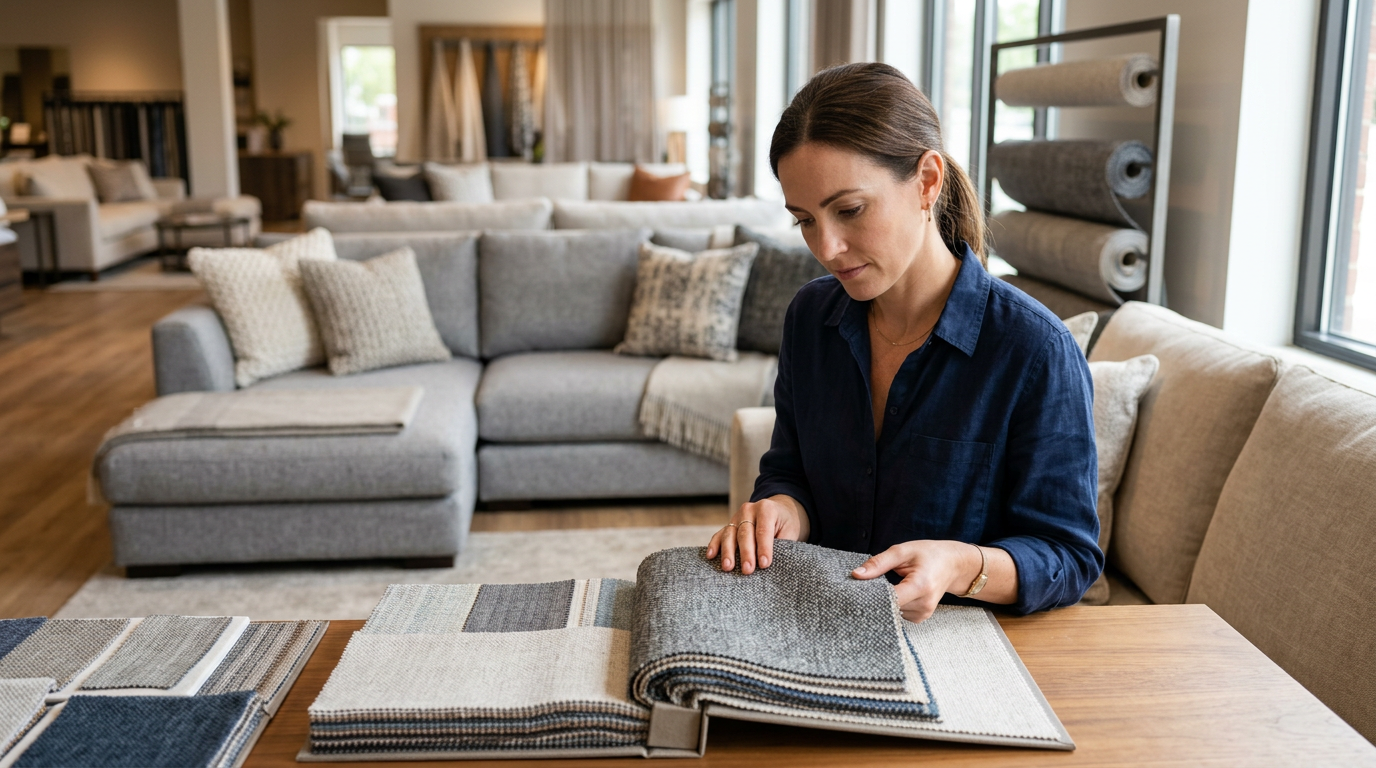
Fabric durability is quantifiable, but showroom conversations rarely go there. The Wyzenbeek double-rub test measures a fabric's abrasion resistance by rubbing it with a standard cotton canvas in alternating directions. The number of cycles the fabric withstands before showing visible wear is its double-rub count. This is one of the most important furniture buying questions you can ask, yet many salespeople won't mention it unless prompted.
Ask: "What's the double-rub test count for this fabric, and does it meet ACT performance guidelines?"
Understanding Double-Rub Thresholds
- Below 15,000 double rubs: Decorative use only. Not suitable for heavy daily use.
- 15,000–30,000 double rubs: Acceptable for light to medium residential use. Suitable for formal living rooms with occasional use.
- 30,000+ double rubs: Heavy residential use. Appropriate for family rooms and daily use.
- 50,000+ double rubs: Commercial-grade durability. Exceeds most residential needs.
The Association for Contract Textiles (ACT) sets voluntary performance standards for commercial fabrics. A fabric that meets ACT guidelines has been tested not just for abrasion but also for colourfastness, pilling resistance, and seam strength. If a fabric is marketed as "premium" but doesn't meet ACT standards, that label is marketing, not material quality.
Beyond the Rub Count: Other Fabric Considerations
Double-rub count measures abrasion resistance, but it doesn't tell the whole story. Also ask about:
- Pilling resistance: Rated 1–5 on the ASTM pill test. Look for a rating of 3 or higher.
- Colourfastness: How does the fabric respond to light exposure and cleaning?
- Cleanability: Is the fabric treated with a stain-resistant finish? Is it solution-dyed (colour runs through the fibre) or piece-dyed (colour applied to the surface)?
- Fibre content: Synthetic blends (like polyester and acrylic) often outperform natural fibres in durability, though they may not feel as luxurious.
Understanding how to shop for a sofa means recognising that fabric is a system of interrelated properties—not a single number. A high double-rub count with poor pilling resistance will still look shabby within a few years.
5. Can Cushions, Springs, and Fabric Panels Be Replaced Individually?
When something goes wrong with your lounge—a stained seat cushion, a torn arm panel, a broken spring—the cost and feasibility of repair depends entirely on how the piece was designed. Some lounges are built modularly, with replaceable components that can be swapped out individually. Others are constructed as integrated units where damage to one part requires reupholstering or replacing the entire piece.
Ask: "If a cushion, spring, or fabric panel is damaged, can it be replaced individually, or does the whole unit need replacement?"
Component-Level Replacement: What to Look For
- Seat cushions: Are they removable and zippered? Can you order a replacement cushion cover without replacing the foam?
- Back cushions: Same questions. Back cushions often flatten before seat cushions, so replaceability matters.
- Arm panels and sides: If your dog scratches an arm panel, can that panel be reupholstered or replaced without dismantling the frame?
- Springs and webbing: Are they accessible from beneath (via a dust cover that can be removed and re-stapled), or are they enclosed permanently?
- Legs: Can they be replaced if damaged, or are they integrated into the frame?
The Cost Implications of Non-Modular Design
A lounge that costs $2,000 but requires full replacement when a seat cushion fails is more expensive over its lifespan than a $3,000 lounge where you can replace a cushion for $150. When salespeople emphasise the purchase price without discussing repair economics, they're framing the transaction as a one-time cost rather than an ongoing relationship with the piece.
Also ask whether replacement components are stocked locally or must be ordered from overseas, and what the typical lead time is. A component that's theoretically replaceable but takes 14 weeks to arrive from offshore is practically unavailable for urgent repairs.
6. Who Bears Responsibility for Delivery Damage—and What's the Inspection Window?
Delivery is the moment of maximum risk for your new lounge. Transit damage—scratched frames, torn fabric, compressed corners—happens between the warehouse and your living room, and the question of who bears responsibility is often murky. Many retailers structure their delivery policies to minimise their liability, placing the burden of inspection and claims on the buyer under tight timeframes.
Ask these specific questions before you commit:
Transit and Delivery Questions to Ask
- "Who bears liability for damage during delivery?" The answer should be the retailer or their contracted delivery service—not you.
- "What inspection window do I have to report damage?" Some retailers require you to note damage on the delivery docket at the time of receipt. Others give you 24–48 hours. Some offer no formal window, making post-delivery claims difficult.
- "If I refuse delivery due to damage, what are the restocking and re-delivery fees?" Refusing a damaged delivery shouldn't cost you money, but some policies charge restocking fees even for retailer-caused damage.
- "What happens if damage is discovered after the delivery team has left?" Hidden damage—like a cracked frame beneath intact fabric—may not be visible at delivery time.
- "Is white-glove delivery included, or is it an add-on?" Standard delivery may involve curbside drop-off, while white-glove service includes placement, assembly, and packaging removal.
Protecting Yourself on Delivery Day
On delivery day, take these steps regardless of what the retailer's policy states:
- Inspect before signing: Once you sign the delivery docket, you've acknowledged receipt. Check every surface, seam, and corner first.
- Take photos: Document any damage immediately, with timestamped images.
- Note issues on the docket: Write "received with damage—see photos" on the delivery slip before signing.
- Don't let the delivery team rush you: They may be on a tight schedule, but you're entitled to inspect your purchase.
A robust lounge buying guide Australia should address delivery as a critical risk point, not an afterthought. The period between purchase and placement is when many lounge purchases go wrong.
7. Where Is the Lounge Actually Manufactured—and What Certifications Apply?
Country of origin labels can be misleading. A lounge tagged "Australian made" may have been assembled locally from imported components. A frame built overseas, foam imported from another country, and fabric from a third source might come together in an Australian workshop—and legally carry the "made in" label. The question isn't just where the final assembly happened, but where the structural components were produced and under what standards.
Ask: "Where is this lounge actually manufactured versus assembled, and what independent certifications apply to the materials?"
Certifications That Actually Mean Something
- FSC (Forest Stewardship Council): Certifies that timber comes from responsibly managed forests. Relevant to frame construction.
- Greenguard / Greenguard Gold: Certifies low chemical emissions from materials. Relevant if you're concerned about indoor air quality or have chemical sensitivities.
- Oeko-Tex Standard 100: Certifies that fabrics have been tested for harmful substances. Relevant to upholstery and cushion covers.
- GECA (Good Environmental Choice Australia): Australian certification covering environmental and health impacts across the product lifecycle.
Why Manufacturing Origin Matters
Manufacturing location affects quality control, material standards, and environmental impact. It's not about nationalism—it's about traceability. A manufacturer that controls its own supply chain can verify material quality at every stage. A company that sources components from multiple offshore suppliers may have less visibility into what's actually inside the finished product.
Also ask whether the manufacturer provides factory tours or has published material specifications. Transparency is a strong indicator of quality confidence. Companies that hide behind vague marketing language—"premium materials," "expert craftsmanship"—without providing verifiable specs are often doing so because the specifics wouldn't support the premium positioning.
Frequently Asked Questions
What's the most important question to ask when buying a lounge?
The foam density and ILD rating question is arguably the most impactful, because cushion compression is the most common reason lounges feel "old" within a few years. A beautiful frame with premium fabric won't feel good if the foam has flattened. However, the warranty exclusion audit is equally critical—it determines what recourse you have when any of the other components fail.
How much should I spend on a quality lounge?
Price alone doesn't guarantee quality, but there are cost floors below which certain construction standards are economically impossible. A lounge priced under $1,500 (AUD) for a three-seater is almost certainly using 1.5–1.8 density foam, staple joinery, and budget fabric. The $2,000–$4,000 range is where you start seeing 2.0+ density foam, dowel or mortise-and-tenon frames, and 30,000+ double-rub fabrics. Above $4,000, you should expect full transparency on all specs and modular component replaceability.
Should I buy a lounge online without seeing it in person?
Online purchasing removes the ability to assess construction quality in person, but it doesn't remove the need for the same questions. Reputable online retailers should provide foam density ratings, frame joinery specifications, fabric double-rub counts, and full warranty documents on request. If they can't or won't, the convenience of online shopping doesn't compensate for the information gap.
How long should a quality lounge last?
A well-constructed lounge with 2.5+ density foam, mortise-and-tenon or dowel joinery, 30,000+ double-rub fabric, and a genuinely comprehensive warranty should last 10–15 years of regular use before major component replacement is needed. If a lounge shows significant wear within 3–5 years, it wasn't built to a quality standard regardless of what the marketing suggested.
Conclusion: Your Interrogation Toolkit
The seven questions in this guide aren't about being difficult or adversarial with salespeople. They're about replacing emotional decision-making with verifiable evidence. A salesperson who can answer all seven questions with specific, documented information is selling a product they stand behind. One who deflects, generalises, or changes the subject is counting on you not to ask.
Before your next showroom visit, write these questions down:
- What joinery does the frame use, and is the timber genuinely solid?
- What are the exact foam density and ILD ratings?
- What does the warranty specifically exclude?
- What's the fabric's double-rub count, and does it meet ACT guidelines?
- Can cushions, springs, and fabric panels be replaced individually?
- Who bears delivery liability, and what's the inspection window?
- Where is the lounge actually manufactured, and what certifications apply?
Bring this list to the showroom. Take notes on the answers. Compare across retailers before making a decision. The small effort of asking these questions upfront can save you thousands of dollars and years of regret. A lounge is a decade-long investment—treat the purchase with the rigour that deserves.
Take the same questions to the lounge furniture range, and look at a modular option such as the Bentley Corner Modular Recliner Suite if a corner layout suits your room.